A roof inspection checklist for East Valley rental properties and multi-unit buildings should cover roof-type-specific wear (tile, flat/foam, or shingle), flashing and penetrations around vents and HVAC curbs, gutter and drainage function, and a clear process for tenant notice, severity ranking, and vendor vetting — done at least twice a year and after any major wind or hail event.
What should a roof inspection checklist cover for rental and multi-unit properties?
A usable roof inspection checklist for a rental or multi-unit property in the East Valley needs more than “look for leaks.” At a minimum, it should document:
- Roof-specific wear — cracked or slipped tile, lifted or curling shingles, blisters or seam separation on flat/foam membranes.
- Flashing and penetrations — chimney, plumbing stack, and swamp cooler or HVAC curb flashing, where most Arizona roof leaks actually start.
- Drainage — gutters, scuppers, and roof drains clear of monsoon-season dust and debris, with water draining away from the building instead of pooling.
- Rooftop equipment condition — HVAC unit anchoring, condensate line staining on the membrane, and solar mounts if the property has panels.
- Prior repair history — install date, last recoat or re-roof, and any open work orders, so the same soft spot isn’t “found” every visit.
- Access and safety notes — whether the roof was viewed from the ground, by drone, or walked, and what fall-protection or access equipment was used.
For a single rental home, a lot of this can be a quick seasonal walk-around. For an apartment complex or commercial building with several roof sections, it needs to become a repeatable form that produces the same level of detail every time, no matter who performs the inspection.
How often should East Valley landlords and property managers inspect roofs?
Twice a year is the practical minimum for Tempe, Mesa, Chandler, and Scottsdale rental and multi-unit roofs: once in late spring, before monsoon season builds, and once in early fall, after it winds down, to catalog any wind, hail, or dust-storm damage before it turns into a leak. Add an inspection any time there’s a reported leak, a major wind event, or visible roof debris in the parking lot or landscaping — don’t wait for the next scheduled visit.
Arizona’s climate adds a wrinkle most generic checklists don’t mention: UV exposure degrades flat and foam roof coatings faster here than in milder climates, so a membrane that “looks fine” on a quick visual pass may already be past its recoat window. Budgeting a coating-condition check into every fall inspection — not just a leak search — catches that before it becomes a capital repair.
Managing roofs across several Tempe or East Valley units and want a second set of eyes before your next inspection cycle?
Single-family rental vs. multi-unit property: how inspections differ
| Factor | Single-family rental | Multi-unit / commercial |
|---|---|---|
| Inspection scope | One roof, one access point | Multiple roof sections, shared and private areas |
| Typical roof type | Tile or shingle | Often flat or foam, sometimes mixed with tile |
| Tenant access | One household to notify | Multiple leases; common-area access usually doesn’t require unit entry |
| Documentation needs | Simple photo log is often enough | Dated reports per section, tied to a capital reserve plan |
| Who usually coordinates it | The landlord directly | A property management company or HOA board |
What roof types are common on East Valley rentals, and what should you check on each?
Most rental houses and smaller multi-unit buildings in Tempe, Mesa, Gilbert, and Chandler have tile or shingle roofs; larger apartment complexes and commercial buildings lean toward flat roofs or foam roof coatings because they’re easier to maintain over long, low-slope spans.
- Tile roofs — check for cracked, slipped, or walked-on tiles (a common issue after HVAC service calls), and confirm the underlayment underneath isn’t the real source of a leak that shows up several feet from the visible crack. See our tile roof repair guide for what a contractor typically checks tile-by-tile.
- Flat and foam roofs — look for ponding water, membrane blistering, and seam separation, and ask when the coating was last renewed; foam systems generally need recoating on a multi-year cycle in Arizona’s UV and heat conditions.
- Shingle roofs — less common on multi-unit buildings here, but still present on some older rental houses; check for curling, missing granules, and nail pops that can telegraph through an attic ceiling.
Whatever the roof type, a routine roof inspection and maintenance visit should note the material, approximate age, and condition side by side, so trends are visible from one inspection to the next instead of each report standing alone.
Tenant notice and access: what Arizona landlords need to know
Arizona’s landlord-tenant statute generally requires reasonable notice, commonly interpreted as at least two days, before entering a tenant’s space for non-emergency work — and that applies even when the work is on the roof rather than inside the unit, if a ladder, lift, or scaffolding will be set up on the tenant’s patio or parking space. For a multi-unit building, inspecting from common areas, a parking lot, or by drone usually avoids the notice requirement entirely, since no individual unit is being entered.
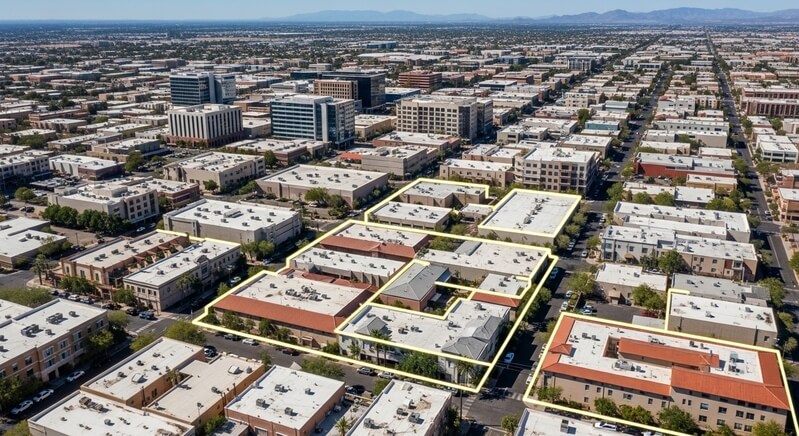
For example, a property manager overseeing a 24-unit complex near the US-60 and Alma School corridor in Chandler might schedule the fall roof walk entirely from common-area roof access and the parking lot, reserving unit-by-unit notice only for the handful of ground-floor units directly below a known trouble spot flagged in the spring inspection.
How do you vet a roofer for a rental or multi-unit property?
Before any contractor gets on a rental or multi-unit roof, it’s worth confirming a few basics:
- Arizona ROC license — verify it’s active and in good standing on the Arizona Registrar of Contractors site before work begins, not after.
- Insurance certificate — ask for a certificate of insurance naming the property or ownership entity as an additional insured, and confirm it hasn’t lapsed.
- Written, itemized estimate — for multi-unit work, get the estimate broken out by roof section or building number, so costs can be tracked against the right capital line item.
- References on similar property types — a contractor who mainly does single-family tile re-roofs may not have the equipment or crew size for a 40,000-square-foot flat roof recoat.
Our guide to commercial roof repair covers more on what to expect from a contractor working on larger, multi-section roofs specifically.
What should you do after the inspection?
Once the walk-through or drone pass is done, sort findings by urgency instead of tackling them in whatever order they were noticed:
- Active leak or safety hazard — get it tarped or temporarily patched promptly, and document it for insurance before any cleanup.
- Water intrusion risk — cracked flashing, failing seams, or ponding that hasn’t leaked yet, but will.
- Cosmetic or wear items — faded coating, minor granule loss — track these for the next capital planning cycle rather than an emergency call.
Keep photos, dates, and the inspector’s notes together in the property file. If storm damage from a monsoon cell is involved, our storm and monsoon damage repair page walks through documenting damage in a way that holds up for an insurance claim.
Frequently asked questions
How often should a rental or multi-unit property in the East Valley get a roof inspection?
At least twice a year — before and after monsoon season — plus an extra check any time there’s a reported leak, a major wind event, or visible roof debris on the ground.
Who is responsible for scheduling roof inspections, the landlord or a property management company?
It depends on the management agreement. For a single rental home, the landlord typically handles it directly. For an apartment complex or HOA-governed property, a property management company or the HOA board usually coordinates inspections and keeps the documentation.
How much notice do Arizona landlords need to give tenants before a roof inspection?
Arizona law generally calls for reasonable notice, commonly treated as at least two days, before entering a tenant’s unit or the space immediately around it for non-emergency access. Inspections done from common areas, a parking lot, or by drone usually don’t require unit-specific notice at all.
What’s different about inspecting a multi-unit or commercial roof versus a single rental home?
Scale and documentation. A single-family rental is usually one roof and a simple photo log. A multi-unit or commercial property often has several roof sections, mixed materials, and needs dated, section-by-section reports tied to a capital reserve plan rather than a one-time note.
Can drone photos replace an on-roof inspection for flat or foam roofs?
Drone photos are useful for spotting ponding, obvious debris, and large membrane damage, but they generally can’t confirm seam adhesion, soft spots underfoot, or coating thickness. Most contractors treat drone passes as a screening step, with an on-roof visit still needed before any repair scope is finalized.
How do I check if a roofing contractor is licensed to work in Arizona?
Look up the contractor’s license number on the Arizona Registrar of Contractors (ROC) website and confirm it’s active, not expired or revoked, before signing any agreement or allowing work to start.
What roof problems show up most often on East Valley apartment and condo complexes?
Ponding water and seam separation on flat or foam roofs, flashing failures around rooftop HVAC units, and gutter or scupper clogging from monsoon-season dust are the most common findings on multi-unit properties in Tempe, Mesa, Chandler, and the surrounding East Valley.
For a deeper look at what a single-property inspection covers item by item, see our roof inspection and maintenance guide, or request a free inspection quote to get a local roofer scheduled for your next inspection cycle. Checking how many shingle layers a roof already carries matters too — see our guide on roofing over existing shingles for what that means for an overlay versus a full replacement.