
If your roof is damaged right now in Gilbert, AZ, the priority order is: get people clear of danger, stop water from spreading inside, photograph everything, and then call for emergency roof repair in Gilbert, AZ before you attempt any fix yourself. What you do in the next hour can matter more for your insurance claim and your ceiling than what happens once the contractor shows up.
What to do first when you discover roof damage
Emergency roof repair in Gilbert, AZ usually starts the same way everywhere: wind, monsoon downburst, or a falling branch tears loose shingles or tile, and water starts finding its way into the attic or a ceiling. Before anything else, check for the two real dangers first.
Look for a ceiling that’s sagging, bubbling, or dripping steadily rather than dripping slowly. A heavy, waterlogged section of drywall can fail without warning, so keep everyone, including pets, out of that room and move furniture only if you can do it from outside the danger zone. Second, if water is anywhere near outlets, light fixtures, or a ceiling fan, shut off power to that circuit at the breaker panel rather than risking it.
Once people and pets are safe, place a bucket, trash can, or large bowl under any active drip, and slide a tarp or plastic sheeting under furniture and flooring nearby. If the ceiling is holding a pocket of water and already sagging, a small, controlled hole poked with a screwdriver at the lowest point can let the water drain into a bucket instead of letting a larger section of drywall give way on its own.
What’s safe to do yourself vs. what to leave alone
Homeowners often want to climb up and assess the damage themselves, but roofs in Gilbert carry real risks that aren’t obvious from the ground: tile roofs crack under foot traffic from anyone who isn’t trained to walk them, and flat or foam roofs can hide soft, saturated decking that won’t support weight even though it looks solid.
| Situation | Safe to do yourself | Leave to the contractor |
|---|---|---|
| Water dripping through a ceiling | Bucket, plastic sheeting, moving valuables | Locating the source above the ceiling |
| Missing shingles visible from the ground | Photograph from the ground or a window | Walking the roof to assess extent |
| Cracked or slipped tile | Noting the general area from the ground | Walking a tile roof (foot traffic breaks more tile) |
| A tarp needs to go up | Having a tarp and rope ready at ground level | Climbing up and securing the tarp itself |
| Standing water on a flat/foam roof | Checking gutters/scuppers at ground level for blockages | Getting on the roof to clear drains or patch membrane |
Have active roof damage right now?
Should you tarp the roof yourself?
This is where advice online gets contradictory, so it’s worth being direct about it: climbing onto a damaged roof to tarp it yourself is one of the more common ways homeowners get hurt after a storm, especially on a wet or tile roof. A damaged roof deck may not hold your weight evenly, ladders on uneven ground are unstable, and a tarp that isn’t properly weighted and secured can rip loose in the next gust and do nothing for you.
If the opening is small and easily reached from a stable attic space or a low, flat section, a temporary interior patch (plastic sheeting and roofing tape over the interior-facing leak point) is lower-risk than climbing onto the exterior roof. For anything on a sloped tile or shingle section, or anything above a second story, it’s safer and usually faster overall to call a licensed contractor from our network for emergency tarping than to attempt it solo, particularly in Gilbert’s summer and early-fall heat, when roof surfaces can be dangerously hot and ladders can be hard to anchor in soft landscaping after rain.
Documenting the damage before the roofer arrives
Insurance claims move faster when there’s a clear record of the damage before any repair work starts. While you wait for a roofer:
- Take wide photos and video of the damaged area from the ground, plus close-ups of any visible cracked tile, missing shingles, or exposed decking.
- Photograph interior damage too: ceiling stains, drips, and anything that got wet, including the date and approximate time.
- Keep any receipts for emergency supplies (tarps, buckets, a wet/dry vacuum) since many policies allow reimbursement for reasonable mitigation costs.
- Write down roughly when the damage happened and what caused it (wind, hail, a falling branch) while it’s fresh.
This same documentation also gives a roofer a faster starting point for a written estimate instead of needing to reconstruct the timeline themselves.
What a local roofer checks when they get there
A contractor responding to an emergency call typically walks the roof to confirm the extent of the damage beyond what’s visible from the ground, checks the surrounding area for secondary damage (flashing, vents, swamp cooler penetrations), and installs a temporary repair, such as a tarp or sealant, to stop water intrusion before scheduling the permanent fix. On tile roofs especially, they’ll often check for tiles that were cracked by the storm itself versus tiles that were already loose or brittle from age and UV exposure, since Gilbert’s sun takes a toll on tile underlayment well before the tile itself fails.
Ask for a written, itemized estimate before any work beyond the emergency tarp begins, and ask whether the temporary repair cost will be credited toward the permanent one.
Gilbert-specific things to know
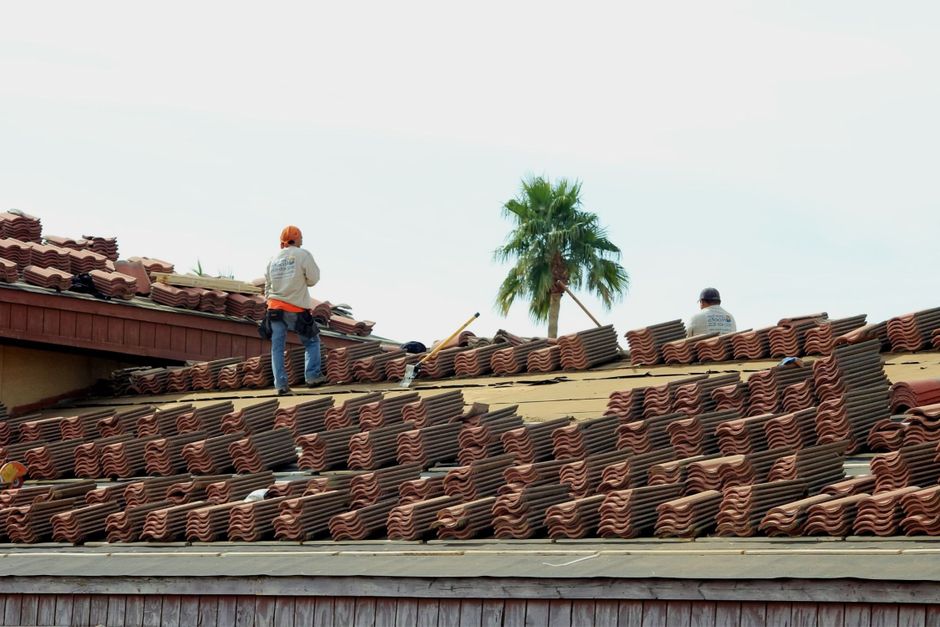
Gilbert’s housing stock skews newer than a lot of the Valley, and that shapes what emergency roof repair in Gilbert, AZ usually looks like. Master-planned communities like Val Vista Lakes, Agritopia, and Power Ranch have a high share of concrete tile roofs, which hold up well in wind but are easy to damage further if someone untrained walks them during an emergency assessment. Many of these neighborhoods also have active HOAs with exterior-appearance rules, so if a tarp or temporary patch will be visible from the street for more than a day or two, it’s worth a quick check of your HOA’s guidelines or a courtesy notice to avoid a separate headache on top of the repair.
For example, a homeowner in Power Ranch who wakes up to missing roof tile after an overnight wind event isn’t just dealing with the roof damage itself; they’re also deciding how fast to get a tarp up before an HOA notices, and whether the eventual repair needs matching tile rather than a visibly different patch. That’s a different set of trade-offs than an older, non-HOA Tempe neighborhood might face with the same damage.
For the permit and approval side of larger repairs or a full tile replacement after storm damage, see our guide to Gilbert roofing permits for repair and replacement, and if the roof in question is already an older tile system nearing the end of its life, our tile roof repair page covers how roofers typically evaluate repair versus full replacement.
Frequently asked questions
How fast can a roofer respond to an emergency call in Gilbert, AZ?
Response times vary by contractor and how widespread the damage is across the area (a single house with a fallen branch gets a faster response than a whole neighborhood after a major storm). Calling as soon as it’s safe to do so, and being ready to describe the damage and its location, helps get you scheduled sooner.
Is it safe to walk on my roof to check the damage myself?
Generally no, especially on tile or a wet/sloped surface. Photograph what you can see from the ground or a window and let a roofer make the up-close assessment; walking a damaged roof risks both your safety and additional cracked tile or shingles.
Should I tarp my own roof after a storm?
Only if the access is low-risk and you’re comfortable on a ladder; for sloped, tile, or multi-story roofs, it’s usually safer and faster overall to have a local roofer handle temporary tarping, since an improperly secured tarp can fail in the next windstorm.
Will my homeowners insurance cover emergency roof repair in Gilbert?
Many policies cover sudden, storm-related roof damage and reasonable costs to prevent it from getting worse, but coverage details vary by policy and cause of damage. Photograph everything before repairs begin and ask your roofer for a written estimate to support your claim.
Do I need HOA approval for a temporary roof tarp in communities like Val Vista Lakes or Agritopia?
Most HOAs allow temporary emergency repairs, but some have notice requirements or limits on how long a visible tarp can stay up. A quick look at your community’s guidelines, or a courtesy heads-up to the HOA, can save a second issue on top of the roof repair itself.
What should I have ready before the roofer arrives?
Photos and video of the damage (inside and out), a rough timeline of when it happened, access to the attic if it’s safe, and clear access to the affected area of the roof from the ground or driveway so the contractor can get set up quickly.
How much does emergency roof repair typically cost compared to a scheduled repair?
Emergency and after-hours response can cost more than a scheduled daytime repair because of the urgency, but getting a temporary fix in place quickly usually costs far less than letting water damage spread to insulation, drywall, and framing.
For damage that’s part of a larger storm event rather than an isolated issue, see our broader guide to storm and monsoon damage repair, and for ongoing leaks that aren’t an active emergency, our roof leak repair page walks through next steps. Call (877) 689-3492 to be connected with a local roofer serving Gilbert and the rest of the East Valley.
Related reading: Emergency Roof Tarping in Tempe, AZ: What to Expect
Related reading: Emergency Roof Repair in Glendale, AZ: First Hours