
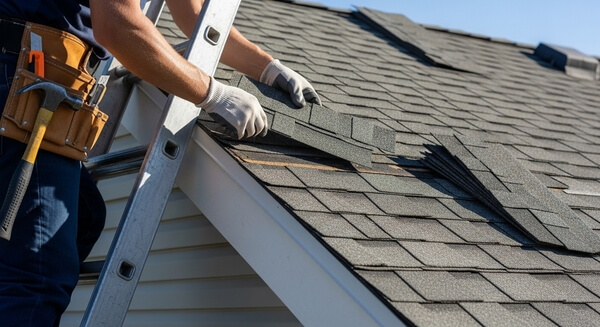
A nail pop is exactly what it sounds like — a roofing nail that has backed partially out of the decking, pushing up the shingle above it and creating a small gap that lets water track underneath, and despite how minor it looks, nail pops are one of the more common causes of leaks that seem to appear “out of nowhere” on an otherwise sound roof.
What causes nail pops
Nail pops happen when a fastener gradually works its way back out of the roof deck rather than staying flush. A few things drive this:
- Thermal expansion and contraction. Arizona’s daily temperature swings between blazing afternoons and cooler nights cause roof decking to expand and contract repeatedly, which can slowly push improperly seated nails outward over years.
- Nails driven at the wrong angle or depth during installation. A nail driven too shallow, too deep, or at an angle is more prone to working loose than one seated correctly and flush.
- Roof deck movement. Minor structural settling or deck flexing under wind load can gradually loosen fasteners that were originally seated correctly.
- Wrong nail length for the decking thickness. A nail that’s too short for the deck material has less holding power and is more prone to backing out over time.
Nail pops share some symptoms with other small-but-significant issues — see our guide on blistering shingles, since both can create small localized bumps that are easy to dismiss as cosmetic.
Noticed small bumps or a mystery leak?
Why such a small issue causes real leaks
A popped nail pushes the shingle above it upward just enough to create a gap, and that gap is often enough for wind-driven monsoon rain to work its way underneath. Worse, a popped nail head sitting exposed above the shingle surface can itself become a direct entry point once the surrounding sealant wears away, essentially creating a tiny puncture straight through to the deck. Because the resulting leak often shows up somewhere else in the attic or ceiling — water travels before it drips — homeowners frequently can’t connect an interior leak to what looks like an insignificant bump on the roof surface.
How to spot nail pops
- Small, localized bumps in a shingle, often in a fairly regular grid pattern matching where fasteners were originally placed.
- A visible metal nail head poking through or very close to the shingle surface, sometimes with rust staining around it.
- Slightly raised or cracked shingle directly over the bump, which can eventually crack fully as the nail continues working outward.
Signs from inside vs. outside the house
| Location | What you might notice | How obvious it is |
|---|---|---|
| On the roof itself | Small raised bumps, visible nail heads, minor cracking | Easy to miss from the ground |
| In the attic | A pinpoint of daylight, or a rust-tipped nail visibly protruding through the decking | Fairly easy to spot with a flashlight |
| On the ceiling below | A small water stain, sometimes far from the actual nail location | Obvious, but misleading about the true source |
How nail pops actually get fixed
- Locate every popped nail, not just the obvious one. Nail pops often occur in clusters from the same original installation batch, so a single visible one is worth checking nearby areas for others.
- Remove or properly re-seat the fastener. A popped nail is typically pulled and replaced with a properly seated one nearby, rather than simply hammered back down, which can crack the shingle further.
- Reseal the affected shingle. Once the fastener issue is corrected, the shingle is resealed to restore its weather seal at that spot.
Our shingle roof repair team handles nail pop repair as part of routine maintenance, and it’s also one of the specific things checked during a preventive roof inspection.
A real-world scenario
A homeowner in Mesa noticed a small water stain on a bedroom ceiling with no obvious roof damage visible from the ground. There had been no recent storm, which made it confusing. An attic inspection found a single popped nail several feet away from where the stain appeared directly below — water had entered at the nail, traveled along the underside of the decking, and dripped down at a lower point entirely. What looked like it might be a bigger roofing problem turned out to be a five-minute fix once the actual source was correctly identified, which is exactly why tracing the real entry point matters more than treating the visible symptom.
Frequently asked questions
Can a single nail pop really cause a leak?
Yes. A popped nail creates a small gap under the shingle and can itself become a direct entry point once surrounding sealant wears away, making it a legitimate leak source despite how minor it looks.
How do I know if a ceiling leak is from a nail pop or something else?
You generally can’t tell from the ceiling stain alone, since water often travels before dripping down. An attic or roof-level inspection is needed to trace the leak to its actual source.
Are nail pops a sign of bad roofing work?
Not necessarily. While improper installation can contribute, thermal expansion and normal deck movement over years can cause nail pops even on a correctly installed roof, especially given Arizona’s wide daily temperature swings.
How much does it cost to fix nail pops?
Nail pop repair is typically one of the less expensive roofing fixes, especially when caught before it’s caused water damage elsewhere. Cost rises if the resulting leak has already caused interior damage.
Can I fix a nail pop myself?
It’s possible for a confident homeowner with roof access, but hammering a popped nail back down without properly re-sealing or replacing it can crack the shingle and make the problem worse rather than better.
Do nail pops show up during a routine roof inspection?
Yes, checking for popped or exposed nails is a standard part of a thorough roof inspection, which is one reason regular inspections catch small issues like this before they lead to a leak.
If you’re dealing with a leak that doesn’t seem to match any visible roof damage, our roof leak repair team traces it to the actual source rather than guessing. Request a free inspection to rule nail pops in or out. Rust is another slow-developing metal issue worth checking alongside popped nails during an inspection — see our guide on rusted flashing: when to repair vs. replace. Overflowing gutters can also loosen fascia boards and nails along the roofline over time — our guide on gutter overflow: causes and fixes covers the warning signs.
Because nails need sound wood to hold, repeated pops can also point to softening decking underneath — our guide on roof deck rot warning signs and repair scope covers when that’s the real problem. Widespread nail pops across a broad section of roof can also be an early sign of a sagging roofline — our guide on sagging rooflines: structural causes explained covers the structural causes behind that.
An old satellite dish mount causes a similar kind of problem — its lag screws can loosen or leave open holes once the dish itself is gone, which our guide on satellite dish removal: roof damage to watch for covers in detail.