
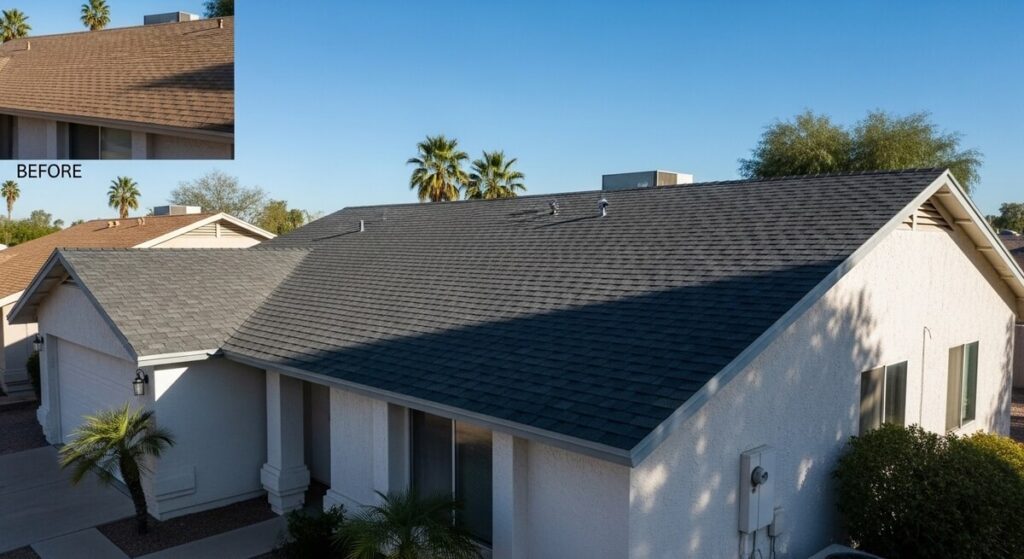
Birds and small pests damage Arizona roofs mainly by nesting under tiles and inside roof vents, and by pecking or scratching at foam and shingle surfaces looking for insects and shelter — problems that start small but lead to torn underlayment, blocked ventilation, and water intrusion if they go unchecked.
Why Arizona roofs attract birds and pests
A roof looks like shelter to a bird or a rodent long before it looks like a house to anyone else. Tile roofs create rows of dark, wind-protected gaps under the barrel or flat profile that mimic a cliff crevice or hollow tree — exactly what pigeons, sparrows, and starlings look for when nesting season starts in spring. Once triple-digit heat sets in, that same gap stays valuable: it’s shaded, cooler than the tile baking in direct sun, and close to attic vents that leak a little conditioned air. Rodents and pack rats are drawn to the same shaded voids, plus any gap around a roof penetration — a pipe boot, a vent stack, an HVAC line — that gives them a route into the attic.
Insects factor in too. Wood-boring and nesting insects attract woodpeckers, which peck through fascia boards, wood soffits, and sometimes foam roofing to get at them. In the East Valley, this shows up most in neighborhoods with mature trees — parts of Tempe, Mesa, and Chandler with established landscaping — since the insects that draw birds in are more common there than in newer, sparsely landscaped subdivisions.
The most common culprits in the East Valley
Pigeons are the most frequent nesting problem on tile and flat roofs, favoring covered ledges, parapet walls, and gaps under loose or raised tiles. Sparrows and finches go for smaller openings — gable vents, gaps under roof-to-wall flashing, satellite dish mounts. Woodpeckers target wood fascia and trim, and occasionally foam-coated roofs where the coating is soft enough to break through. Roof rats and pack rats climb from trees or fences onto the roofline and get into attics through any gap larger than about a half-inch, chewing insulation and sometimes wiring once inside. None of these animals need much of an opening — a lifted tile, a cracked vent screen, or pulled-away flashing is enough.
How the damage actually happens
The damage is rarely from the animal’s presence alone — it’s from what nesting and digging does to the materials underneath. On a tile roof, birds lift and shift tiles to create nesting space, which breaks the tile’s seal against wind-driven rain and exposes the underlayment beneath it. Nesting material can also block the small drainage channels tile systems rely on, so water backs up under the tiles instead of running off — a similar failure mode to the drainage issues covered in our guide to why roof valleys leak more than other areas, just caused by a nest instead of storm debris.
On foam roofing, pecking breaks the protective coating and exposes the closed-cell foam to UV light and moisture, so a small pecked spot can turn into a soft, saturated area within a season or two — the same vulnerability discussed in our piece on why foam roof coatings crack and blister. On shingle roofs, birds and squirrels can lift shingle edges to nest underneath, breaking the seal strip that keeps wind from getting under the shingle.
Rodents cause a different kind of damage: chewed attic insulation, gnawed wiring insulation (a fire hazard, not just a nuisance), and enlarged entry gaps that let in more water and more animals over time. Droppings and nesting debris that accumulate in attics or gutters also hold moisture against wood framing, a slower but real contributor to rot in an area that otherwise stays dry most of the year.
| Roof type | Main risk | What to watch for |
|---|---|---|
| Tile | Nesting under lifted or broken tiles, blocked drainage channels | Shifted tiles, droppings near eaves, birds flying in and out of one spot repeatedly |
| Foam-coated | Pecking through the coating; UV/moisture exposure at the break | Small pecked holes, soft or discolored patches, exposed foam texture |
| Asphalt shingle | Lifted shingle edges creating nesting pockets; seal-strip damage | Curled or raised shingle corners, nesting material tucked at the edge |
| Metal / standing seam | Nesting at panel ends and around penetrations, not the panels themselves | Debris packed into seam ends, vent covers pushed loose |
| Flat / low-slope | Roof-rat and pack-rat access via parapet gaps; pigeon roosting on equipment | Droppings around HVAC units, chewed insulation near equipment curbs |
Hearing scratching in the attic or seeing birds going in and out of the same spot on your roofline?
What an inspection actually checks for
A roofer looking for bird and pest damage isn’t just checking for animals — they’re checking for the structural consequences. That means lifting a sample of tiles near any nesting activity to check the underlayment condition, inspecting vent screens and pipe boots for chew marks or gaps, checking attic insulation for compression or nesting material, and looking at fascia and soffit wood for peck holes or soft spots. This overlaps closely with a standard roof inspection and maintenance visit, which is why catching pest activity early often costs nothing extra if it’s flagged during a routine check rather than found later as a leak.
Warning signs you have an active problem
- Birds repeatedly flying to and from the same spot along the roofline, especially in spring nesting season
- Droppings accumulating on the roof surface, gutters, or ground below one section of eave
- Scratching, chirping, or scurrying sounds from the attic, especially around dawn or dusk
- Visible nesting material — twigs, grass, insulation fibers — poking out from under tile edges or vent covers
- A musty or ammonia-like smell in the attic, which usually means droppings have accumulated over time
- Chewed or frayed wiring insulation visible from the attic access point
- Small holes or pecked patches on foam roofing or wood fascia
Any of these on their own is worth a look. Multiple signs together, or anything involving chewed wiring, should move to the top of the list — wiring damage is a fire risk, not just a roofing one.
What to do if you find nesting or damage
Active bird nests are often protected by law during nesting season, so removal timing and method matter — a roofer familiar with local wildlife patterns can advise what’s appropriate rather than clearing a nest outright. For rodents, exclusion (sealing entry points after confirming the space is empty) works better long-term than trapping alone, since trapping without sealing the opening just means a new animal moves in. Once the animal issue is addressed, the roofing repair follows the same process as any other localized damage: reset or replace affected tiles, patch or recoat damaged foam, replace compromised shingles, repair exposed underlayment or decking. If it’s already led to a leak, see our guide on roof leak repair, and if debris has worked into gutters, our notes on gutter repair cover the flow issues that can follow.
Preventing bird and pest damage
Prevention is cheaper than repeated repair, and most of it comes down to removing easy entry points before nesting season. Bird netting or spikes on flat ledges and parapet walls (common on commercial roofs) discourage roosting without harming birds. Mesh screens over gable and ridge vents block the small gaps rodents and sparrows use to get in — metal, not plastic, holds up better against chewing. Trimming tree branches back from the roofline removes the easiest access route, since most of these animals prefer to climb or hop onto a roof rather than land directly from flight. Scheduling a roof inspection ahead of spring nesting season and again before monsoon season — roughly the cadence in our guide on how often you should get a roof inspection — catches loose tiles and early nesting before it turns into a repair.
A common East Valley scenario
A typical case: a homeowner in a tree-lined part of Mesa or Chandler notices a pair of pigeons flying to the same roof corner every morning for a couple of weeks. By the time anyone gets a ladder up there, several tiles near that corner have shifted, there’s nesting debris packed into the gap, and a faint water stain has started on the garage ceiling below — wind-driven rain from an earlier storm found its way through the disturbed tiles before anyone knew there was a problem. The fix is straightforward once it’s found: clear the nest at an appropriate time, reset the tiles, repair the small wet section of underlayment, and add netting or a physical barrier so the corner doesn’t attract another nest next season. The expensive version is the one where nobody checks until the stain is already large and the underlayment beneath several tiles has failed.
Frequently asked questions
Do birds actually cause real damage to a roof, or is it just a mess?
Both. Droppings and noise are a nuisance, but the structural issue is what the nesting displaces — lifted tiles and blocked drainage channels that let water in during the next storm. The nest itself is rarely the expensive part; the water intrusion it enables is.
What time of year are birds most likely to nest on Arizona roofs?
Spring is the peak nesting period for most species common in the Valley, though mild winters can extend activity for pigeons and doves. Checking the roofline in late winter, before nesting starts, is the best window for prevention.
How do I know if it’s birds or rodents making noise in my attic?
Daytime scratching and chirping usually points to birds; sounds concentrated around dawn and dusk, or a scurrying pattern, more often points to rodents. Either way, a single inspection can usually tell which one it is.
Can I remove a bird nest from my roof myself?
Active nests with eggs or chicks may be protected depending on the species and timing, and getting onto a tile or foam roof without training risks cracking tiles or puncturing coating that then needs its own repair. It’s usually simpler and safer to have a roofer handle removal and the resulting repair in one visit.
Will homeowners insurance cover damage caused by birds or pests?
Coverage varies and often excludes damage attributed to pest infestation or lack of maintenance, though resulting water damage may be treated differently depending on the policy. Our guide on whether homeowners insurance covers roof damage in Arizona walks through how these claims are typically evaluated.
Are certain Tempe or East Valley neighborhoods more prone to this?
Areas with mature, established trees — older sections of Tempe, Mesa, and Chandler — tend to see more woodpecker and insect-related activity, since the insects that attract birds are more common there. Newer subdivisions see somewhat less, though pigeons and rodents aren’t picky about landscaping age.
Does pest damage void a roof warranty?
Many manufacturer and workmanship warranties exclude damage caused by animals, since it falls outside normal wear. That’s part of why catching and repairing it promptly matters — letting it progress into a bigger structural issue is more likely to affect coverage than the original nesting itself.
Can pest damage happen on a roof that was recently replaced?
Yes. A new roof removes existing damage but doesn’t change what attracts birds and rodents in the first place — shade, shelter, and nearby food or insects. Gaps around vents and penetrations should still be screened on a new roof just as on an older one.
Bird and pest damage tends to hide in plain sight — a nest tucked under a tile edge or a small pecked hole in foam coating doesn’t look urgent until it’s already let water in. If you’ve noticed birds returning to the same spot on your roof or heard activity in the attic, a roof inspection can catch it while the fix is still small, and our team can walk you through what we find and what it would take to get it repaired before the next monsoon season tests it. If the sounds you’re hearing are more scurrying than fluttering, our deeper guide on packrat and rodent damage to roof systems covers what to check specifically for rats and packrats in the attic. And since a tree limb close enough for birds to nest on is also close enough to abrade or damage the roof itself, our guide on overhanging tree branches and roof damage is worth a look too.