
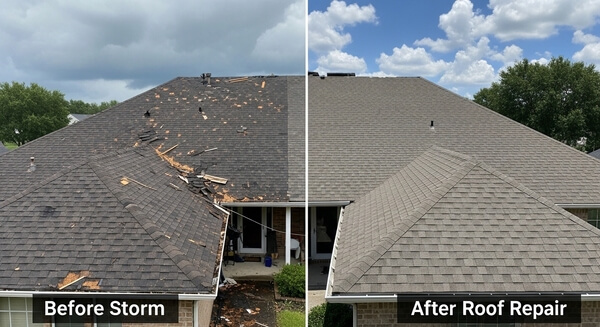
Microburst wind damage is one of the most common reasons Tempe homeowners call for storm damage roof repair in August. A microburst is a column of cold air that collapses out of a monsoon thunderstorm and slams into the ground, spreading outward in every direction. Across the Phoenix area these bursts regularly produce gusts strong enough to lift shingles, crack and slide tile, peel back flat-roof coatings and flip patio covers, often in a neighborhood-sized area while the next street over barely notices.
This guide explains what a microburst actually does to a roof, which roof types in the East Valley are most vulnerable, what damage to look for from the ground, and when a wind-damaged roof needs an emergency repair instead of a routine appointment.
What is a microburst, and why is it so hard on roofs?
A microburst forms when rain and hail falling through dry desert air evaporate, chill the air around them, and make that air heavier than its surroundings. The cooled air drops out of the storm like water poured from a bucket. When it hits the ground it fans out in a ring of straight-line wind, usually within a few miles of where it touched down, and usually for only a few minutes.
That short, concentrated burst is exactly what makes microbursts so damaging. Most roofs are designed and fastened to resist steady wind. A microburst delivers a sudden pressure change instead: wind rushes across the roof surface, creates uplift on the leeward side and at the edges, and pries at anything that isn’t fully bonded. Roof edges, rakes, ridges and corners take the worst of it, which is why the first damage we find after a microburst is almost always along the perimeter of the roof rather than in the middle of a slope.
Because the Valley’s dry lower atmosphere is ideal for evaporative cooling, Arizona monsoon storms are especially good at producing microbursts. That is why the same storm can leave one Tempe block with scattered branches and another with shingles in the yard.
How does microburst wind damage differ by roof type?
Every common roof system in Tempe fails a little differently under a burst of straight-line wind. Knowing which pattern to look for helps you spot problems early.
| Roof type | What usually fails first | What to look for from the ground |
|---|---|---|
| Asphalt shingle | Sealant strips release, tabs lift and crease, ridge caps and starter rows blow off | Missing shingles, bright spots of exposed underlayment, shingles in the yard or gutters |
| Concrete or clay tile | Loose or poorly fastened tiles lift, slide or crack; ridge and hip tiles shift | Gaps in the tile pattern, broken pieces on the ground, crooked ridge lines |
| Foam (SPF) | Coating edges peel, flashing at parapets tears, debris gouges the surface | Flapping or curled coating at edges, dents or punctures from blown debris |
| Flat membrane / built-up | Perimeter flashing and seams lift, membrane balloons, gravel scours | Loose metal edge, wrinkled or billowed membrane, gravel washed into gutters |
| Metal panel | Panel edges and trim pull fasteners, ridge caps loosen | Bent trim, lifted panel corners, rattling during later wind |
Shingle roofs show damage fastest because a lifted tab is easy to spot. Tile roofs are trickier. A tile can be cracked or shifted just enough to open a path for water without looking obviously wrong from the street, which is why tile roof repair after a wind event almost always starts with a hands-on inspection rather than a drive-by glance.
Seeing lifted shingles or missing tile after this week’s wind?
What should you check after a microburst passes?
Once the storm has passed and it is safe to go outside, walk the property before you ever consider a ladder. Most of the useful information is visible from the ground:
- Yard and driveway debris. Pieces of shingle, tile fragments, granules washing out of downspouts or strips of flashing are the clearest signs something came loose.
- Roof edges and ridges. Use binoculars or your phone’s zoom to scan the rake edges, eaves and ridge line. Straight lines that now look wavy or broken deserve a closer look.
- Gutters and downspouts. Bent or detached gutters often mean the fascia behind them took a hit too.
- Patio covers, carports and ramadas. These attached structures catch wind like sails and can tear the roof edge they are fastened to.
- Inside the house. Check ceilings in rooms along the windward side, closets and the garage for fresh stains, and take a flashlight into the attic if it is safe to do so.
Take dated photos of everything before anything is moved or cleaned up. If your roof was also hit by a dust storm, our guide to haboob debris damage covers the abrasion and clogged-drainage problems that often come along with microburst winds.
Why microburst damage is often hidden
The most expensive microburst damage is the kind nobody sees for weeks. Shingles whose sealant strips released during the gust can lie back down and look normal, but they are no longer bonded, so the next storm lifts them easily. Tiles that were raised and dropped can crack the underlayment’s protective overlap without breaking themselves. Flat-roof seams can open by a fraction of an inch.
None of this leaks right away. It shows up during the next heavy rain as a stain that seems to come from nowhere. That delay causes most of the frustration with wind claims, and it is why a professional inspection within days of the storm is worth more than one done after the leak appears. A roofer can hand-test shingle seals, lift tile to check the underlayment and probe seams, then document what was caused by the storm while the timeline is still clear.
Is it an emergency, or can it wait for a scheduled repair?
Not every piece of wind damage needs a crew tonight. A simple rule we use with Tempe homeowners:
- Call for emergency roof repair if you can see exposed roof deck, water is actively coming into the house, a large section of shingles or tile is gone, or a structure such as a patio cover has torn away from the roof edge. More rain is common during monsoon season, and open decking can soak through in a single storm. Our emergency roof repair team can tarp and dry-in the area the same day.
- Schedule a prompt inspection if you see a few lifted shingles, a handful of displaced tiles, debris in the yard, or bent flashing but no interior water. These still need attention within days, not months.
- Keep an eye on it if the only sign is a little debris and the roof looks straight and intact. It is still smart to have it checked at your next routine visit, especially if the roof is more than 15 years old.
How can you reduce microburst damage next time?
You cannot stop a microburst, but you can make your roof a much harder target:
- Have loose or cracked tile reset and fastened before monsoon season, with extra attention to the first rows at the eaves and the ridge and hip tiles.
- On shingle roofs, ask whether your starter strips and ridge caps are properly sealed. That is where wind gets its first grip.
- Keep trees trimmed well back from the roofline so limbs cannot whip against the surface or come down on it.
- Make sure patio covers and shade structures are attached to framing, not just to fascia boards.
- Schedule a roof inspection and maintenance visit each spring so fastening problems are fixed while the weather is calm.
A roof that is well fastened at the edges is usually the difference between a small repair after a microburst and a full insurance claim.
If a microburst has loosened shingles or tile on your home, our roof repair team in Tempe can secure the damage and document it for your insurer.
Related reading: Securing Patio Covers and Ramadas Before a Monsoon Storm
Frequently asked questions
What is a microburst?
A microburst is a sudden, concentrated downdraft of cold air from a thunderstorm that hits the ground and spreads out as straight-line wind, usually over an area of a few miles or less and for only a few minutes.
Can a microburst damage a roof without a tornado?
Yes. Microbursts produce straight-line winds, not rotation, but the gusts can be strong enough to lift shingles, slide or crack tile, peel flat-roof coatings and tear patio covers away from the roof edge.
Which parts of a roof are most vulnerable to microburst winds?
Edges, rakes, corners and ridges experience the highest uplift, so shingle starter rows, ridge caps, eave tiles and perimeter flashing are usually the first components to fail.
How do I know if my shingles lost their seal in the wind?
Unsealed shingles often look normal from the ground. A roofer can gently lift the tabs to test the adhesive bond. Creased tabs, a wavy appearance or shingles that flap in later breezes are warning signs.
Is microburst damage covered by homeowners insurance in Arizona?
Sudden wind damage is commonly covered under many homeowners policies, while wear and tear is not. Coverage depends on your specific policy and deductible, so document the damage with dated photos and review your policy or call your agent.
How soon should I get my roof inspected after a microburst?
Ideally within a few days, before the next monsoon storm. Early inspection catches loosened shingles and shifted tile before they leak and makes it easier to show that the damage came from a specific storm.
Should I go on my roof myself after a wind storm?
We recommend staying on the ground. Wind-loosened tile and shingles can shift underfoot, and wet or dusty surfaces are slippery. Binoculars and a phone camera show most of what you need to see.
Microbursts are part of every monsoon season in the Valley, and most of the damage they cause is fixable when it is caught early. If a storm has passed through your part of Tempe, Mesa, Chandler or Scottsdale and something on your roof looks different, reach out to Tempe Roofing Repair at (877) 689-3492 or through our contact page. We will inspect, document and repair it before the next storm finds the weak spot. You can also read more about our storm and monsoon damage repair services.