
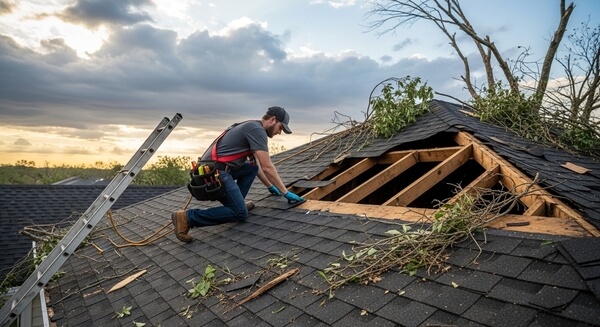
A haboob damages a roof mainly through what it carries, not the wind itself — airborne gravel, tree limbs, patio furniture, and trash cans travel at 40-60+ mph and strike roof surfaces hard enough to crack tiles, tear shingles, and puncture foam coatings, while the dust cloud itself packs vents, gutters, and rooftop equipment with grit that causes problems weeks later. Both effects matter, and both are common across Tempe and the East Valley several times a monsoon season.
How haboob dust storms damage a roof
A haboob is a wall of dust and sand pushed ahead of a collapsing monsoon thunderstorm’s outflow — the same downburst that later brings rain and lightning. The dust itself is mostly a visibility and air-quality problem, but the wind carrying it routinely gusts into the 40-60 mph range across the Phoenix metro, and gusts at that speed do two distinct kinds of roof damage: direct wind load at ridge caps, flashing edges, and marginal tile or shingle tabs, and impact damage from everything the wind picks up along the way. A haboob rarely arrives alone — it’s usually followed within 20-60 minutes by the rain and lightning of the storm cell behind it, so damage from the dust wall often gets discovered at the same time as fresh water intrusion, which makes the two easy to confuse during a post-storm walk-around.
Wind-driven debris: the bigger threat
Most of the damage attributed to “the dust storm” is actually impact damage from what the wind was carrying: dead palm fronds, mesquite and palo verde branches, gravel from unlandscaped lots, unsecured patio umbrellas, trash and recycling bins that weren’t brought in, and loose roofing material shed from a neighboring building. Any of these striking a roof at highway speed can crack a concrete tile, punch through a foam coating, dent a metal panel, or knock enough granules off a shingle to expose the asphalt mat underneath. Overhanging tree branches are a particular risk during haboob season, since the same wind that’s about to drop a limb is also strong enough to fling smaller debris from farther away — a well-trimmed property can still take a hit from a neighbor’s yard three lots over.
Because impact damage is often localized to one slope or corner, it’s easy to miss from the ground. A cracked tile near a ridge or a shingle with a fresh bruise mark doesn’t leak immediately — it leaks the next time wind-driven rain finds that weak point, which in Arizona is usually the very next monsoon cell.
Dust infiltration into vents, coils, and gutters
The dust cloud itself does slower, quieter damage. Fine sand works into ridge, static, and soffit vents, gradually reducing the attic airflow a roof deck depends on to shed summer heat — a poorly vented attic runs hotter, which accelerates the UV and thermal-cycling breakdown already stressing shingles and foam coatings under Arizona’s heat. Dust also settles into rooftop HVAC coils and can restrict drainage at scuppers and roof drains on flat and foam roofs, so a dust event followed by heavy rain is a common setup for ponding that wouldn’t have happened otherwise. Gutters and roof valleys collect dust and grit the same way they collect leaves, and a valley packed with sediment sheds water poorly during the next downpour — one more reason valleys are consistently the leakiest part of a roof, as we cover in our piece on why roof valleys leak more than other areas. None of this is dramatic on its own, but it compounds: a roof that goes into monsoon season with clogged vents and sediment-packed valleys is already behind before the next storm arrives.
Haboob damage by roof type
Different roofing materials respond to wind-driven debris differently. The table below covers what typically happens and what to prioritize checking after a dust storm passes through Tempe, Mesa, Chandler, Scottsdale, or Gilbert.
| Roof type | Most common damage | What to check first |
|---|---|---|
| Concrete/clay tile | Cracked or slipped tiles from branch and debris impact; broken tile edges near ridges and hips | Walk the roofline visually for shifted or missing tiles — don’t walk the tile surface yourself |
| Asphalt shingle | Granule loss and bruising from impact, lifted or torn tabs from wind gusts | Check gutters for fresh granule buildup and look for discolored or curling patches |
| Flat / built-up | Punctures from debris, drains and scuppers blocked by dust and grit | Clear drains before rain arrives; look for standing water after the next storm |
| Foam (SPF) | Gouges or torn coating from sharp debris, accelerated UV wear where coating is scuffed | Look for exposed foam (yellow or tan patches) where the protective coating is missing |
| Metal | Dents, scuffed finish, loosened fasteners at panel seams | Check exposed fastener heads and panel edges for movement |
Not sure whether last night’s dust storm actually did anything to your roof?
What to check after a haboob passes
A short ground-level check after any haboob catches most of what matters before it turns into a leak. Look at the yard and roofline for anything that could have struck the roof — broken branches, a missing patio umbrella, a neighbor’s trash can against your fence. Scan gutters and downspouts for a sudden buildup of granules, tile fragments, or dust sediment, and check that gutters are still attached and not pulled loose, since our gutter repair team sees plenty of gutters knocked loose by the same gusts that carry the dust. If rain followed behind the haboob, watch ceilings and light fixtures for a day or two afterward — a slow drip from impact damage often shows up hours after the storm clears, not during it. Anything beyond a ground-level check — walking the roof, inspecting tile or coating up close, checking flashing at penetrations — is worth leaving to a professional; our guide on roof inspection and maintenance covers what a full post-storm inspection includes.
If the storm caused visible interior damage — water intruding, a hole you can see daylight through, a section of roof that’s clearly compromised — that’s an emergency-repair situation, not a wait-and-see one; see our first hour after storm damage guide for exactly what to do and who to call.
Reducing debris damage before the next one
You can’t stop a haboob, but you can reduce what it has to throw at your roof. Trim branches back from the roofline before monsoon season starts, and remove any dead or weak limbs a 50 mph gust would snap anyway. Secure or store loose patio furniture, umbrellas, and anything else in the yard that isn’t tied down — these are consistently among the most common debris sources after East Valley dust storms. Bring in trash and recycling bins before a storm is forecast rather than after it arrives; forecasters typically flag a haboob risk hours ahead of the visible wall of dust. On the roof itself, clearing vents, valleys, and drains before monsoon season keeps them from becoming impact points or drainage bottlenecks once storms start rolling through regularly.
Does insurance cover haboob damage?
Wind and debris-impact damage from a haboob is typically covered under standard homeowners policies the same way other wind and storm damage is, though coverage details and deductibles vary by insurer. Photograph debris and damage before cleanup, since adjusters rely heavily on that timestamp. For a full breakdown of what’s usually covered versus excluded, see does homeowners insurance cover roof damage in Arizona.
A common East Valley scenario
A typical case looks like this: a haboob rolls through a Chandler or Gilbert neighborhood in late afternoon, followed twenty minutes later by the monsoon cell behind it. The dust wall does little visible damage, but a dead palo verde branch from a few doors down lands near a roof valley during the peak gusts, cracking two tiles and dislodging the underlayment slightly — invisible from the ground. When rain arrives right behind the dust, water finds that fresh crack immediately, and a ceiling stain shows up in a hallway within the hour. Because dust, wind, and rain arrive so close together, it’s easy to blame “the storm” generally rather than a single piece of debris that caused one specific, fixable failure point.
Frequently asked questions
Can a haboob damage a roof even without rain?
Yes. The wind and debris in a haboob can crack tiles, tear shingles, dent metal, and puncture foam coating on their own. Rain from the storm cell behind the dust wall just makes existing damage show up faster as a leak.
How do I know if dust storm damage is serious enough to call someone?
Any visible crack, puncture, missing material, or interior water intrusion warrants a professional look. A quick inspection is far cheaper than letting hidden damage sit through several more storms.
Should I try to inspect my own roof after a haboob?
A ground-level visual check is useful, but walking on tile or foam roofing without experience risks causing additional damage — tile especially cracks under foot traffic from anyone who doesn’t know where it’s safe to step.
Why does dust in my attic vents matter if the roof isn’t leaking?
Blocked vents reduce attic airflow, and a hotter, poorly ventilated attic accelerates heat and UV-related wear on the roofing material above it — a slower problem than a leak, but one that shortens the roof’s useful life.
Do haboobs cause more roof damage than the monsoon storms themselves?
Not usually in total, but they cause a specific kind — impact damage from airborne debris — that pure rain and lightning events don’t. The two often arrive close enough together that damage from each gets blamed on “the storm” as a whole.
How often do haboobs actually hit the Phoenix area?
The Phoenix metro sees multiple significant dust storms most monsoon seasons, typically between June and September, with gusts frequently in the 40-60 mph range during the more intense events.
Will trimming my trees really reduce roof damage from dust storms?
It reduces what your own property contributes, but a roof can still be hit by material from neighboring yards. It’s still worth doing, since it removes the largest, most damaging debris you have direct control over.
Can dust storm debris damage cause a leak that shows up weeks later?
Yes — a cracked tile or torn underlayment doesn’t always leak on the first rain after impact. A leak often shows up during a later, heavier storm once the damaged spot has been exposed to enough wind-driven rain.
Dust and debris from monsoon-season haboobs are a normal part of owning a roof in the East Valley, and most of the damage they cause is preventable or catchable early with a quick post-storm look. If a dust storm has come through your neighborhood recently, our monsoon roof damage guide covers the full range of storm-related issues to watch for, and our storm and monsoon damage repair team can take a closer look at anything a ground-level check can’t confirm.