
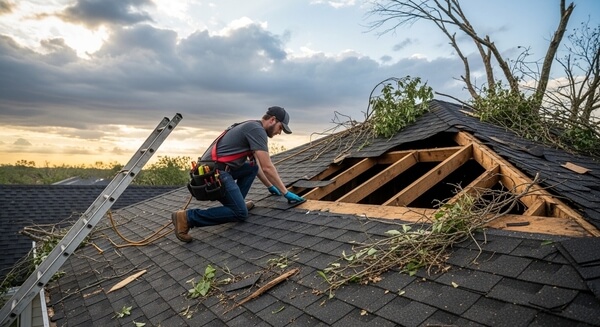
If you've lived in the Valley through even one monsoon season, you already know the pattern: weeks of triple-digit heat, then a wall of dust rolling in off the desert, followed by wind gusts that snap tree limbs and rain that falls sideways for twenty minutes before the sky clears again. Roofs take the brunt of all of it, and not always in ways that are obvious from the ground.
We inspect roofs across Tempe, Mesa, Chandler, Scottsdale, Phoenix, Gilbert, Ahwatukee, and Guadalupe every monsoon season, and the same story repeats: a homeowner notices a small stain on the ceiling weeks after a storm, or a property manager gets the call during the third storm of the season instead of the first. This guide covers what actually causes monsoon roof damage, the warning signs worth checking for on every roof type common in the Valley, what repairs typically cost, and how to tell the difference between damage you can watch and damage that needs attention today.
Why Arizona monsoons are uniquely hard on roofs
Monsoon storms in Arizona don't behave like ordinary rain events, and neither does the damage they cause. The National Weather Service classifies a severe thunderstorm as one producing wind gusts of 58 mph or higher, or hail an inch or larger — and Valley monsoon cells regularly meet that bar, sometimes several times in a single season. What makes local roofs especially vulnerable isn't just the wind itself, it's the sequence leading up to it.
Every roof in Tempe and the surrounding cities spends months absorbing direct desert sun before the first real storm arrives. Asphalt shingles soften slightly in that heat, sealant strips and flashing caulk can dry out and lose flexibility, and foam and elastomeric coatings on flat roofs go through repeated expansion cycles. Then a storm hits: temperatures can drop sharply within minutes as outflow winds arrive ahead of the rain, followed by a sudden temperature swing once the rain itself starts. That heat-then-shock cycle stresses materials in a way that steady, moderate climates simply don't produce, and it's a big part of why roofing installed and maintained the same way performs differently here than it would in, say, the Pacific Northwest.
What actually causes monsoon roof damage
Most monsoon roof damage in the Valley traces back to one of five mechanisms, often in combination during the same storm:
- Wind uplift. As wind moves across a roof, it creates a pressure difference at edges, ridges, and any spot where a shingle, tile, or panel isn't fully secured — the classic mechanism behind missing shingles and shifted tile. Roofing materials are tested and rated for wind resistance (asphalt shingles, for example, are commonly rated under manufacturer standards referencing ASTM wind-uplift testing), but an aging or already-loose roof performs well below its rated resistance.
- Haboob abrasion and debris. A dust storm's leading wall carries fine sand and grit at speed, which gradually wears down shingle granules and roof coatings over repeated events, and the wind gusts that accompany it can pick up and fling loose debris hard enough to crack tile or dent metal.
- Hail. Less frequent here than in some parts of the country, but Valley monsoon cells do produce hail large enough to bruise shingles, crack tile, and dent metal roofing and vents in a given season.
- Heavy rain overwhelming aging materials. A roof with existing small gaps in flashing, worn pipe boots, or degraded underlayment that's held up fine through light rain can leak the moment a monsoon cell drops a heavy volume of water in a short window.
- Direct impact. Downed tree limbs, wind-thrown patio furniture, or lightning strikes are less common but do real, immediate structural damage when they happen.
Warning signs of monsoon roof damage
Some damage is obvious the morning after a storm. A lot of it isn't, which is exactly why insurance-covered wind and hail damage so often gets caught weeks late, after a small problem has already become a leak.
What to look for outside
- Missing, curled, or visibly lifted shingles, especially near ridges and roof edges
- Cracked, chipped, or displaced tile — even a single shifted tile exposes the underlayment beneath it
- Granules collecting in gutters, downspouts, or on the ground near downspout outlets
- Dented metal panels, vent caps, or gutters — often the clearest visible sign of hail
- Standing water on a flat or foam roof more than 24–48 hours after rain has stopped
- Torn, lifted, or separated flashing around chimneys, skylights, and roof penetrations
- Broken or clogged gutters, or downspouts pulling away from the fascia
What to look for inside
- New stains or discoloration on ceilings, especially in top-floor rooms and closets
- Soft, sagging, or bubbling drywall or ceiling texture
- A musty smell that wasn't there before the storm
- Visible daylight through the attic roof deck or unusually bright attic light spots
- Peeling paint or bubbling on interior walls near the roofline
If any indoor signs show up, that typically means water has already found its way past the roofing and underlayment — at that point, the priority shifts from "watch and see" to getting a leak diagnosed and stopped before the next storm adds to it.
Seeing any of these signs after a recent storm? A same-day inspection tells you exactly what you're dealing with.
Call (602) 782-5490How each roofing material holds up through monsoon season
The Valley has more roofing material diversity than most metro areas — tile, shingle, flat, foam, and metal are all common, often within the same neighborhood. Each responds to monsoon stress differently.
Tile (concrete and clay)
Tile itself is heavy, UV-stable, and generally wind-resistant when properly installed, which is why it dominates so much of the Valley's housing stock. The vulnerability isn't usually the tile — it's the underlayment beneath it. Once that felt or synthetic underlayment ages, cracks, or gets exposed by even one shifted or broken tile, wind-driven rain finds a path underneath the tile field where it can travel and pool before ever showing up as a visible leak. Tile roof repair after a storm often means resetting or replacing a small number of broken tiles and inspecting the underlayment condition around them, not replacing the whole field.
Asphalt shingle
Shingle roofs are the most directly exposed to wind uplift and granule abrasion from haboobs, and the softening effect of months of desert heat makes an aging shingle roof measurably more vulnerable than a newer one carrying the same wind rating. Reputable manufacturers including GAF and CertainTeed publish wind-resistance ratings for their shingle lines, but a rating only holds if installation, sealant strips, and nailing pattern are still intact — which is exactly what a post-storm shingle roof repair inspection checks first.
Flat and foam roofing
Flat and spray-foam roofs, common on additions, patios, and commercial buildings, live or die by drainage and coating integrity. Ponding water that sits for more than a day or two after a monsoon storm is the clearest sign something's off — either a low spot has developed or a drain or scupper is blocked. Small punctures or worn spots in the elastomeric coating are easy to miss until they've let water reach the foam substrate underneath. Foam roof repair and flat roof repair both start with confirming the coating is still fully intact and drainage is working the way it was designed to.
Metal
Standing seam and corrugated metal roofing generally has excellent wind performance when panels and fasteners are properly installed, and it isn't vulnerable to granule loss the way shingle is. The two things that actually cause monsoon damage on metal are loosened fasteners working free over time — which lets wind get underneath a panel edge — and hail dents, which are usually cosmetic but occasionally serious enough to compromise a seam. Metal roof repair after a storm is mostly about refastening and reseating panels before a small lift becomes a bigger one.
Repair options: what gets fixed vs. what gets replaced
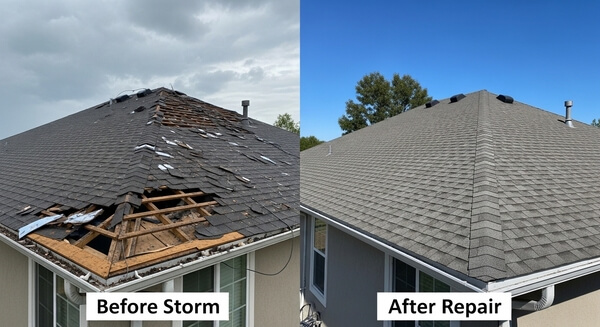
Most monsoon damage is a repair, not a replacement. A section of missing shingles, a handful of cracked tiles, a resealed flashing point, a refastened metal panel, or a patched foam coating are all standard, contained fixes that a licensed crew handles in a single visit once the damage is documented. Emergency roof repair exists specifically for the in-between step — tarping an active leak or exposed section immediately, then scheduling the permanent fix once materials and the full scope are confirmed.
Replacement enters the conversation in three situations: the roof was already near the end of its expected service life before the storm hit, the storm exposed widespread underlayment or decking failure rather than an isolated spot, or repeated storm-related repair calls over a couple of seasons start costing more in total than one properly planned roof replacement would. None of that is guessable from the ground — it's exactly what a documented roof inspection is for.
What monsoon roof repair typically costs in Arizona
Every number below is a planning range, not a quote — the only way to get an exact price is a walked inspection that measures the actual scope, material, and roof access involved. With that caveat:
- Emergency tarping: typically priced at the lower end of the isolated-repair range as a temporary measure to stop active water intrusion the same day.
- Isolated repairs (missing shingles, a cracked tile section, resealed flashing, a resecured metal panel): commonly $200–$2,500 depending on material and scope.
- Larger repair involving multiple roof sections or underlayment replacement in a limited area: moves above that range depending on square footage affected.
- Partial or full replacement, when storm damage exposes systemic underlayment or decking failure: commonly $8,000–$25,000 depending on material — see our full roof replacement cost breakdown for a material-by-material range.
Two things push a monsoon repair estimate toward the higher end of any range: decking condition once damaged roofing is pulled back (rot underneath isn't fully knowable until the covering is removed), and how much of the roof's underlayment was compromised versus just the surface layer.
DIY vs. professional repair — what's actually safe to do yourself
There's a real difference between reasonable homeowner steps and climbing onto a wet, damaged roof, which is one of the more common ways a storm-damage situation turns into an injury.
Reasonable to do yourself: photographing visible damage from the ground, a ladder at eave height, or an upstairs window; clearing obviously blocked gutters from ground level if it's safe to reach; placing buckets under an active indoor drip and moving furniture or electronics out of the water's path; and calling for emergency service the same day rather than waiting.
Better left to a licensed crew: walking the roof surface itself, especially wet tile or shingle, which is significantly more slippery and prone to cracking underfoot than dry roofing; any tarping that requires roof access, since an improperly secured tarp can pull loose in the next wind event and cause more damage than it prevents; and any diagnosis of whether underlayment or decking was compromised, since that isn't visible from outside the roofing layer.
Insurance and documentation
Most Arizona homeowner policies cover wind and hail damage from a specific storm event, though the details — deductibles, what counts as "storm-related," and documentation requirements — vary by policy and are worth confirming directly with your insurer or agent rather than assuming. What consistently helps a claim move faster: dated photos of the damage taken before any repair or tarping, a written and itemized estimate rather than a verbal number, and, where possible, photos of any temporary tarp once it's in place, since adjusters look for evidence that reasonable steps were taken to prevent further damage. Our storm and monsoon damage assessments are documented specifically with insurance claims in mind.
It's also worth being deliberate about who does the work. Every monsoon season brings door-to-door crews canvassing damaged neighborhoods with same-day contracts — verifying a contractor's Arizona Registrar of Contractors (ROC) license before signing anything is a five-minute step that avoids a much bigger problem later.
Pre-monsoon and post-storm maintenance checklist
Before monsoon season (late spring)
- Schedule a full roof inspection to catch loose flashing, worn sealant, or cracked tile while it's a small fix
- Clear gutters and downspouts so heavy rain has somewhere to go
- Trim tree limbs that overhang the roofline
- Confirm attic ventilation isn't blocked, which affects how materials handle heat-then-storm cycling
After every significant storm
- Walk the yard and driveway for visible debris, granules, or displaced roofing material
- Check ceilings and attic spaces for new stains or moisture
- Photograph anything unusual before assuming it's minor
- Schedule an inspection if there's any doubt — most storm damage that becomes expensive was avoidable at the small-fix stage
The National Roofing Contractors Association recommends the same basic pattern nationally: inspect before your region's severe-weather season, and again after any event capable of causing damage — it just happens twice as often here, given how many storms a single Valley monsoon season can bring.
Monsoon roofing across the Valley
Monsoon storms don't hit every part of the Valley identically, and the roofing stock they're hitting varies block by block:
- Tempe mixes ASU-area rental properties with older tile and shingle neighborhoods near Mill Avenue and the Kyrene corridor, where roof age varies widely house to house.
- Mesa spans a historic tile-heavy core alongside newer far-east construction in areas like Eastmark and Las Sendas, so damage patterns and repair needs differ significantly by neighborhood.
- Chandler's newer HOA communities around Ocotillo and Fulton Ranch tend to have younger roofing, but HOA architectural standards still shape how a repair or tile match gets approved.
- Scottsdale homeowners, especially in HOA-governed communities, often need tile color and profile matched precisely, which can add a short approval step to an otherwise straightforward repair.
- Phoenix neighborhoods near Tempe, including Arcadia and the Biltmore area, carry a wide mix of vintage and updated roofing that responds differently to the same storm.
- Gilbert covers everything from historic agricultural-era homes to newer Agritopia-era construction, meaning roof age and material vary block by block.
- Ahwatukee sits against South Mountain, and monsoon outflow winds funneling around the mountain can hit harder and more unpredictably than in more open parts of the Valley.
- Guadalupe's small, dense footprint means a fast, localized response after a storm rather than covering wide travel distance between calls.
Wherever you're located across the East Valley, the same core process applies: document, tarp if there's active water intrusion, and get a professional assessment before deciding between repair and replacement.
Final thoughts
Monsoon season isn't optional in Arizona, and neither is the wear it puts on a roof — but the damage that turns into an expensive problem is almost always the damage that sat unaddressed through a second or third storm, not the damage from the first one. A roof that gets inspected before the season starts and checked again after any significant storm rarely turns a monsoon into a five-figure repair bill.
If you're not sure whether what you're looking at is cosmetic or something that needs attention now, that's exactly what a free inspection is for — no pressure, no obligation, just a straight answer about what your specific roof needs.
How do I know if my roof has monsoon damage?
Start with a walk around the yard and driveway: look for granules collecting in gutters or downspouts, missing or lifted shingles, cracked or displaced tile, dented metal panels or vents, and standing water on a flat roof more than 48 hours after rain. Inside, check ceilings and top-floor closets for new stains, soft spots, or a musty smell. Not all damage is visible from the ground, which is why a free inspection after any significant storm catches issues before they become leaks.
Does homeowners insurance cover monsoon roof damage in Arizona?
Most Arizona policies cover wind and hail damage from a specific storm event, though coverage details, deductibles, and separate wind or hail deductibles vary by policy. Document damage with dated photos before any repair, then get a written, itemized estimate, since a verbal quote typically doesn't satisfy an adjuster. Every policy is different, so confirming your specific coverage with your insurer or agent is the only way to know for certain what's included.
How much does monsoon roof damage repair cost in Arizona?
Isolated repairs — missing shingles, a section of cracked tile, resealing flashing — commonly run $200 to $2,500 depending on scope and material. Emergency tarping to stop an active leak is typically priced at the lower end of that range as a temporary measure ahead of the full repair. If a storm exposed a bigger problem, like widespread underlayment failure or decking rot, cost moves toward partial or full replacement, commonly $8,000 to $25,000 depending on material and roof size. A free inspection is the only way to know which category a specific roof falls into.
What's the difference between repairing and replacing a storm-damaged roof?
Repair makes sense when damage is isolated and the surrounding roofing and underlayment are still sound — a handful of shingles, one cracked section of tile, a torn flashing seal. Replacement becomes the better math once a roof is already near the end of its expected lifespan, when storm damage exposes systemic underlayment failure across large sections, or when repeated repair calls start adding up to more than one properly planned replacement would cost. A documented inspection after the storm tells you which side of that line your roof is on.
How long can a roof leak sit before it causes mold?
There's no single fixed timeline, since it depends on how much water intrudes, what material it's sitting in, and ventilation — but active moisture trapped in insulation or drywall can begin supporting mold growth within days rather than weeks. That's why tarping an active leak quickly and scheduling the repair soon after matters more than the size of the visible damage might suggest.
What roofing material holds up best in Arizona monsoons?
Every material used in the Valley — tile, shingle, foam, flat, and metal — can perform well through monsoon season when it's properly installed, maintained, and within its service life. Concrete and clay tile handle wind and heat well but rely on intact underlayment beneath the tile. Standing seam metal has strong wind performance when properly fastened. Higher wind-rated shingles hold up better than older or lower-grade shingle roofs. Foam and flat roofing depend heavily on the coating staying intact and drainage working properly. Maintenance condition matters as much as material choice.
Can a dust storm (haboob) actually damage my roof, or does it just make it dirty?
Blowing dust and sand create fine abrasion on shingle granules and roof coatings over repeated events, and airborne debris carried in a haboob's leading wind gusts can loosen already-weakened shingles, tile, or flashing. A single haboob rarely causes major damage to a sound roof on its own, but combined with the wind gusts that typically follow it, and repeated over multiple storms each season, it accelerates wear that eventually shows up as a leak.
Should I get my roof inspected before or after monsoon season?
Both, ideally. A pre-monsoon inspection in late spring catches loose flashing, cracked tile, or worn sealant while it's a small fix, rather than letting the first big storm turn it into a leak. A post-storm inspection after any significant wind or hail event confirms whether that specific storm caused new damage, even if nothing is visibly leaking yet.
Is it safe to inspect my own roof after a storm?
Walking the roof itself isn't recommended, especially on wet or debris-covered surfaces where tile and shingle become far more slippery and prone to cracking underfoot. A visual check from the ground, a ladder at eave height, or an upstairs window is a reasonable first look — a full inspection of the roof surface itself is safer left to a professional with the right equipment.
How do I avoid storm-chaser roofing scams after a monsoon?
Verify Arizona ROC (Registrar of Contractors) licensing before signing anything, be wary of door-to-door crews offering same-day contracts or demanding full payment upfront, and get a written, itemized estimate rather than a verbal number. Legitimate local contractors are typically comfortable with a homeowner taking a day to compare estimates; pressure to sign immediately is a common red flag.
Can extreme heat before a storm make monsoon damage worse?
Yes. Arizona roofing spends months absorbing intense heat before the first monsoon storm arrives, which can leave asphalt shingles softer and more prone to wind lift, and can leave some coatings and sealants more brittle depending on age. That heat-then-storm cycle, repeated every summer, is one of the reasons roofing in the Valley wears differently than the same materials would in a milder climate.
How quickly should storm damage be repaired?
As quickly as possible once it's identified, especially anything involving an active leak or exposed roof deck. Even damage that isn't actively leaking yet — a cracked tile, a section of lifted shingle — is one storm away from becoming one, so scheduling repair before the next system moves through the Valley is safer than waiting.