
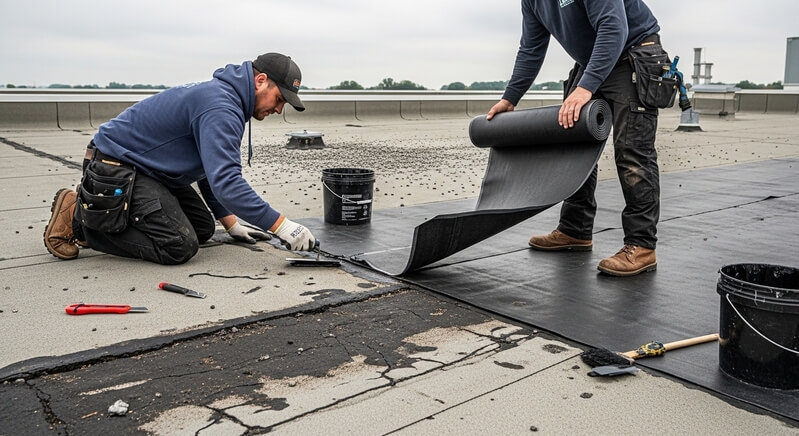
Sealant around a roof penetration typically lasts 5 to 10 years in Tempe’s climate before UV exposure and monsoon temperature swings cause it to crack, shrink, and pull away—and once it fails, water follows the fastener or pipe straight into the roof deck, often for months before a ceiling stain gives it away. Every place something passes through a roof—a plumbing vent, a flashing collar, an HVAC line, a mounting bracket—depends on sealant as a secondary defense, and that sealant is the first thing Arizona’s climate destroys.
Why sealant fails faster around Arizona roof penetrations
Roofing sealant is a flexible compound, and flexibility is exactly what Arizona’s heat and monsoon cycle attack. On a Tempe roof, surface temperatures regularly swing from over 150°F in direct summer sun to well under 100°F within minutes once a monsoon cell rolls in and dumps rain. That thermal shock makes the roofing material around a penetration expand and contract at a different rate than the metal, PVC, or rubber boot it’s sealed against, and the sealant bridging that gap has to stretch and compress every single cycle. Most sealants can only absorb so many of those cycles before they lose elasticity, and once a sealant goes rigid, it cracks instead of flexing—usually along the exact seam it was supposed to protect.
UV degradation compounds the problem. Unlike shingles or tile, which are engineered with UV-resistant coatings, exposed sealant beads have no real protection once applied. Arizona gets some of the highest annual UV exposure in the country, and that constant bombardment breaks down the polymer chains in silicone, polyurethane, and asphalt-based sealants alike, leaving a chalky, brittle residue that no longer bonds to anything. Add in dust from haboob storms working into hairline cracks and monsoon wind-driven rain finding any gap under pressure rather than just falling straight down, and a sealant joint that might last 15 years in a milder climate can fail in half that time here.
The penetration points that fail most often
Not every penetration on a roof is equally vulnerable, and knowing where sealant failure tends to start first helps prioritize an inspection.
Plumbing vent boots. The rubber or plastic collar around a plumbing vent pipe is usually the first thing to go—the boot material itself degrades from UV exposure faster than the sealant around its base, and once the boot cracks, sealant alone can’t compensate.
Chimney and skylight flashing edges. Anywhere flashing meets a vertical surface, a bead of sealant is doing work that step flashing and counterflashing are supposed to do mechanically. When that sealant fails, water gets behind the flashing instead of running over it—see our guide on common causes of roof leaks around chimneys and skylight leak causes and fixes for more on how these specific penetrations behave.
HVAC condensate lines and roof-mounted equipment feet. Anywhere a contractor drilled a fresh hole for a line set or bolted down an equipment stand, the seal is only as good as whoever applied it that day.
Old satellite dish and antenna mounting brackets. Even removed hardware leaves behind lag bolt holes that were sealed once and never revisited.
Solar racking attachment points. A growing category in Tempe as more homes add solar, and one where the sealant is doing more work than most homeowners realize—our solar panel installation and roof puncture risks article covers the mounting-point failure mechanics in more depth.
| Repair approach | Typical lifespan | Best used for |
|---|---|---|
| Spot recaulking (silicone/polyurethane bead) | 1–3 years in AZ sun | Very minor hairline cracks, as a stopgap only |
| New rubber/thermoplastic vent boot | 8–12 years | Cracked or shrunken plumbing vent collars |
| Reflashing with new step/counterflashing + sealant | 15–20+ years | Chimneys, skylights, wall-to-roof transitions |
| Elastomeric/liquid rubber penetration boot | 10–15 years | Irregular penetrations (pipes, conduit clusters, equipment stands) |
Not sure whether a penetration on your roof needs a new bead of sealant or a full reflash?
Warning signs sealant has already failed
Sealant failure rarely announces itself at the source—by the time you can see the damage from the ground or the attic, water has usually been getting in for a while. Look for a stain on the ceiling below any vent stack, chimney, or roof-mounted equipment, since that’s almost always downstream of a penetration rather than an open field of shingles or tile. In the attic, check for dark streaking or rust on nail heads directly under known penetration points, and run a hand along vent boots and flashing collars from a ladder (never walk a tile roof directly) to feel for sealant that’s gone hard, chalky, or has separated into a visible gap. If you’ve had a roof inspection recently, our guide on how often you should get a roof inspection covers how often penetrations specifically should be checked, since they fail well before the rest of the roof surface typically does.
Why just recaulking usually isn’t a real fix
A tube of caulk from the hardware store is the most common DIY response to a leaking penetration, and it’s also why so many of these leaks come back within a year or two. Fresh sealant applied over old, failed sealant doesn’t bond well—it sticks to the degraded surface, not to the roofing material underneath, so it fails again on roughly the same schedule as whatever it was applied over. It also does nothing to address whatever caused the original seal to fail in the first place, whether that’s a boot that’s simply reached the end of its service life, flashing that was never installed correctly, or a fastener that’s backed out and needs to be reset. A proper repair removes the old sealant entirely, inspects the underlying flashing or boot for damage, replaces components that have degraded rather than just resealing them, and only then applies fresh sealant as the final step—not the whole repair. For a broader look at what separates a real fix from a temporary patch, see our roof leak repair page and our roof inspection and maintenance services.
A typical Tempe scenario
A common pattern shows up every fall after monsoon season ends: a homeowner notices a small brown ring on a bedroom ceiling that wasn’t there in July. Tracing it back, the source is usually a plumbing vent boot two feet away on the roof surface, with a boot that’s gone stiff and cracked around its base where it meets the pipe. The homeowner may have recaulked the visible crack a year earlier after a smaller version of the same stain appeared, which bought a season but didn’t address the boot itself. By the time the second stain shows up, water has typically been tracking down the vent pipe and along a rafter for weeks, which is why the fix at that point usually needs to include checking the surrounding decking for moisture damage, not just replacing the boot.
Failed sealant is a quick repair when it is done right. If you are seeing cracked caulk around vents, pipes or skylights, schedule a roof repair in Tempe before monsoon or winter rain finds the gap.
Frequently asked questions
How long should roof sealant around a penetration last in Arizona?
Most sealants used around vent boots, flashing, and mounting hardware last 5 to 10 years here, roughly half of what the same product achieves in a milder climate, because of intense UV exposure and repeated thermal cycling between summer heat and monsoon rain.
Can I just add more caulk if I see a crack around a vent pipe?
You can as a short-term stopgap before monsoon season, but fresh sealant applied over failed sealant or a cracked boot typically fails again within a year or two since it doesn’t bond well to degraded material and doesn’t fix whatever caused the original failure.
How do I know if a leak is coming from a penetration versus a general roof surface problem?
Ceiling stains that appear directly below or slightly downhill from a vent stack, chimney, skylight, or roof-mounted equipment are almost always penetration-related, since these points fail well before the surrounding roofing material typically does.
Does homeowners insurance cover sealant failure around roof penetrations?
Coverage depends on the cause and your policy—gradual wear from sealant aging is generally treated as routine maintenance rather than a covered loss, while sudden storm damage that displaces flashing or a boot may be covered. See our guide on whether homeowners insurance covers roof damage in Arizona for how insurers typically draw that line.
Which roof penetrations fail first on a typical Tempe home?
Plumbing vent boots usually fail first because the boot material itself degrades from UV exposure, followed by chimney and skylight flashing edges where sealant is doing work that mechanical flashing should be doing instead.
Is it normal for a new roof to already need sealant work around penetrations?
It shouldn’t need major work in the first few years, but it’s worth having penetrations checked at the first annual inspection since installation quality varies and a poorly seated boot or under-sealed flashing edge can fail well before the rest of a new roof would.
Can I inspect roof penetrations myself without getting on the roof?
You can check for ceiling stains and attic-side streaking from inside the house, and you can often spot obvious cracking in vent boots from a ladder at the roof edge, but tile and steep-slope roofs are safer left to a professional for a full penetration check.
What’s the difference between a vent boot and flashing?
A vent boot is a molded rubber or thermoplastic collar that fits around a round pipe penetration, while flashing is formed metal used at broader transitions like chimneys, walls, and skylights—both rely on sealant as a secondary barrier, but they fail differently and need different repair approaches.
Sealant around a roof penetration is a maintenance item with a real expiration date in Arizona’s climate, not a one-time install-and-forget detail, and catching it early is far cheaper than repairing the decking damage that follows a missed one. If you’re dealing with an active leak, our roof leak repair team can trace it to the source, and if it’s been a while since your penetrations were checked, our roof inspection and maintenance program covers exactly this kind of point-of-failure before it becomes a ceiling stain.
A swamp cooler curb is one of the busiest versions of this problem, since it combines a flashed seam with mounting bolts and duct penetrations all in one spot — see our guide on swamp cooler roof leak points for the specific spots to check.
That same sealant breakdown shows up at the very top of parapet walls, too — see our guide on parapet wall coping failures on flat roofs for how that specific detail fails and gets repaired.
Related reading: see our guide to roof flashing repair in Tempe, AZ for a breakdown of flashing types, costs, and warning signs.