
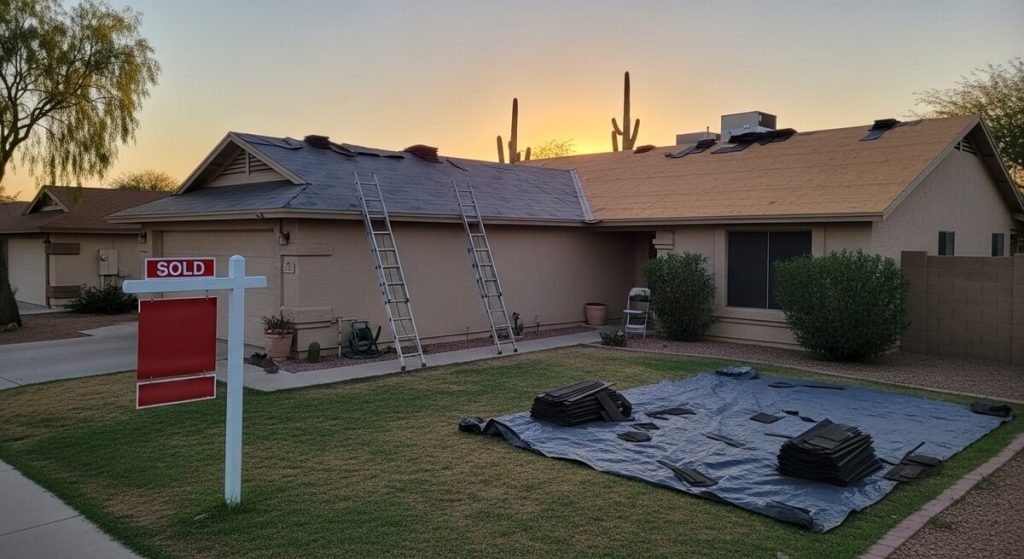
A roof inspection in Surprise, AZ needs a different checklist depending on the house: a builder-warranty walk-through for a new build in a growing subdivision, or a decades-of-sun tile check in an established, age-restricted neighborhood like Sun City Grand. Here’s what we look at first for each, and why the two inspections rarely look the same.
What makes roof inspection in Surprise, AZ different
Surprise spans some of the newest subdivisions in the West Valley alongside some of its oldest age-restricted communities, and a roof inspection in Surprise, AZ has to account for both. A house in a 2024 phase of a master-planned community is still inside its builder’s roof warranty window. A home in Sun City Grand, built out starting in the mid-1990s, has a concrete tile roof that has already been through 25-plus Arizona summers. The materials, the failure points, and even who’s responsible for the fix are different in each case, so “check the roof” means something different depending on which street you’re standing on.
New build roofs: what builder warranties do and don’t cover
New construction roofs fail less often, but not never. The issues we see most on builder-warranty homes are installation shortcuts rather than material age: underlayment fastened too sparsely along ridges, boot flashings around plumbing vents that were never sealed correctly, and tile that was reset after trade work (solar, HVAC, cable) without matching the original underlayment lap.
Most builder structural warranties in Arizona run one to two years on workmanship and longer on structural components, but that coverage is narrow. It typically excludes storm damage, anything altered by a subcontractor after closing, and gradual wear. If you bought in the last two years, get an independent roof inspection before your workmanship warranty window closes — it’s the cheapest leverage you’ll ever have to get a builder-installed defect fixed for free instead of out of pocket.
| Factor | New build (0-3 years) | Established / Sun City Grand era |
|---|---|---|
| Most common issue | Incomplete flashing seals, disturbed tile from trade work | Cracked or slipped tile, brittle underlayment, worn ridge mortar |
| Who may be responsible | Builder warranty (if within window and unaltered) | Homeowner, insurer (if storm-related) |
| Underlayment condition | Should be intact; check anyway | Often original — the real question, not the tile |
| Inspection priority | Penetrations, valleys, trade disturbance | Underlayment life, ridge/hip lines, ponding on flat sections |
| HOA/CC&R factor | Tile style pre-approved at construction | Repairs often need matching tile approval |
Not sure which category your roof falls into?
Sun City Grand and older neighborhoods: what decades of sun do to tile
Sun City Grand and the older sections of Surprise near it are built almost entirely on concrete tile over a felt or synthetic underlayment, which is standard across the Phoenix metro but ages on a predictable timeline. The tile itself can outlast the house. The underlayment underneath it usually can’t — Arizona’s UV exposure and repeated 110°F-plus attic cycling dry out and crack felt underlayment well before the visible tile shows any obvious wear. That’s why a roof that “looks fine from the driveway” can still be past due for a tile roof repair or a full underlayment replacement (sometimes called a lift-and-relay, where the existing tile is set aside, new underlayment goes down, and the original tile is reinstalled).
The other pattern specific to these neighborhoods: single-story homes with long, low rooflines and multiple valleys, which means more linear feet of flashing per square foot of roof than a typical two-story new build. More flashing seams is more places for a slow leak to start, so valley and penetration checks matter more here than they do on a simpler new-build roofline.
Why late September is the right time to check your roof
Arizona’s monsoon season runs through the end of September, and this year’s pattern brought the mix of high heat and heavy, localized storm cells that tends to stress both tile and flat sections — cracked or lifted ridge and hip tiles are consistently among the most common storm-related callouts we and other Valley roofers see once monsoon activity picks up. Once the season winds down, that’s the window to have any storm-loosened tile, clogged flat-roof drains, or wind-lifted flashing addressed before winter’s cooler, calmer weather makes small problems easy to ignore — and before the next season starts stacking new damage on top of anything that went unrepaired. If your neighborhood took any hail, dust, or wind hits this summer, an end-of-monsoon check is the cheapest time to catch it. See our storm and monsoon damage repair page for what a post-storm check usually finds.
HOA and CC&R rules for roof repairs in age-restricted communities
This is the part most general roofing guides skip: Sun City Grand and many nearby Surprise communities are governed by an HOA with CC&Rs that specify roof tile color, profile, and sometimes manufacturer, to keep streetscapes consistent. That means a repair isn’t just a roofing decision — it’s an approval process. Before tile is replaced, most HOAs want either a matching-tile confirmation or an architectural review submission, and mismatched tile from a rushed repair is one of the more common (and avoidable) HOA violation notices we hear about from homeowners in these communities. Ask your roofer to document the tile profile and color match before work starts, and keep that documentation in case the HOA asks later.
New-build communities have a lighter version of the same issue: the builder’s original tile selection is usually pre-approved for the subdivision, so as long as repairs use matching material, most new-build HOAs don’t require a separate submission — but it’s still worth confirming with your HOA documents rather than assuming.
Signs you need a professional inspection now
A homeowner in a Sun City Grand-adjacent neighborhood called us this month after noticing a faint ceiling stain that appeared right after a storm and then seemed to dry up and disappear within a week. That “disappearing” stain is a common trap — the water isn’t gone, it’s soaking into insulation and drywall between visible leak events, and the stain only shows up again during the next storm. In her case, a targeted repair at one displaced ridge tile solved it, but only because it was caught before a second storm pushed more water through the same gap.
Get a professional look sooner rather than later if you notice any of these:
A ceiling or wall stain that appears after storms, even if it fades between them. Granules collecting in gutters or at downspouts on a shingle section. Visible daylight through the attic at a ridge or valley. Tile that looks slightly out of alignment compared to the tiles around it. Ponding water on a flat or foam-roofed patio addition more than 48 hours after rain. Any of these on their own can be minor; more than one together usually means it’s time for a full inspection rather than a spot check.
Related reading: Drone Roof Inspections: How They Work and When to Use One
Frequently asked questions
How often should a new build roof be inspected in Surprise, AZ?
Once before your builder’s workmanship warranty expires (commonly the one- or two-year mark), and then roughly every two to three years after that, or right after any major monsoon storm.
Does my Sun City Grand HOA need to approve a roof repair?
Most communities require tile color and profile to match the existing roof, and some ask for a submission before work starts. Check your specific CC&Rs or HOA office, since requirements vary by neighborhood even within Surprise.
Is concrete tile still the standard roofing material in Surprise?
Yes. Concrete tile dominates residential roofing across Surprise and the wider Phoenix metro, with flat foam or membrane sections typically limited to patio covers, additions, and some garages.
How long does tile roof underlayment last in Arizona?
Traditional felt underlayment under tile in the Phoenix area often needs attention well before the 20-year mark because of sustained UV and heat exposure, even when the tile above it still looks fine. Synthetic underlayment used in newer builds is rated for longer service life.
What does a builder roof warranty typically not cover?
Most builder warranties exclude storm and weather damage, anything altered by another trade after closing, and normal wear. They’re meant to cover installation defects, not the full life of the roof.
Can a roof leak show up, then seem to go away on its own?
Yes, and it’s one of the most common things homeowners misread. Water intrusion after a storm can dry out between weather events even though the underlying gap or displaced tile is still there, so the leak returns with the next rain.
Do new construction homes in Surprise need gutters checked too?
Yes. Builder-installed gutters and downspouts can be undersized for monsoon downpour rates, and debris from nearby landscaping construction is common in the first couple of years.
What’s the difference between a roof repair and a lift-and-relay?
A repair addresses a specific spot — a cracked tile, a failed flashing seal. A lift-and-relay removes the existing tile, replaces the underlayment across the whole roof plane, and resets the original tile, which is common on older tile roofs where the underlayment has failed but the tile itself is still good.
For related reading, see how this same new-build-versus-established pattern plays out in Peoria and Glendale, or how tile slippage shows up on aging tile roofs.
Whether you’re closing out a builder warranty on a new build or maintaining a decades-old tile roof in Sun City Grand, the fastest way to know where you stand is a real inspection rather than a guess from the driveway. We also serve Peoria homeowners dealing with the same new-build-versus-established mix. Contact us to schedule a roof inspection in Surprise, AZ.
Getting ready for next year’s storms? See our West Valley monsoon roof prep checklist for Glendale, Peoria and Surprise.
Related reading: for a Tempe-focused look at inspection costs by type and what gets checked, see our guide to roof inspection cost in Tempe, AZ.