
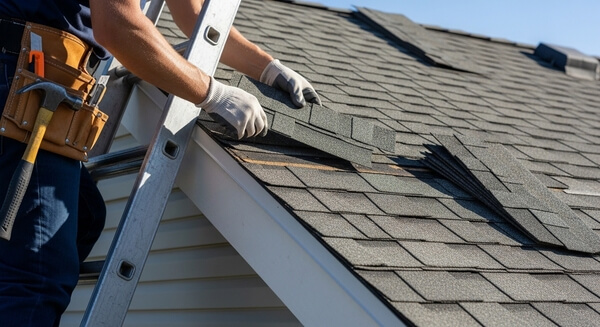
Granule loss is when the small mineral granules embedded in the surface of asphalt shingles wear away and expose the black asphalt layer underneath — a light, even amount is normal as shingles age, but patchy bald spots, shiny asphalt, or granules collecting in gutters and downspouts mean the shingle has lost the UV protection it needs and is aging faster than it should.
What granule loss actually is
Asphalt shingles are built in layers: a fiberglass or organic mat, coated in waterproof asphalt, topped with a layer of small ceramic-coated mineral granules pressed into the surface while it’s still tacky. Those granules aren’t decorative. They do three jobs — they shield the asphalt underneath from direct UV exposure, they add fire resistance, and they give the shingle enough weight and texture to shed water properly. Over the life of a roof, a small number of granules always come loose. Manufacturing leaves a bit of excess that washes off in the first few rains after installation, and normal weathering sheds more, very gradually, every year after that.
Granule loss becomes a problem when it happens faster than that slow baseline, or when it happens unevenly — bald patches on south- and west-facing slopes, shiny or slick-looking spots where you’d expect a matte, granulated surface, or asphalt that’s visibly darker in isolated areas rather than uniformly across the whole roof.
Why Arizona’s climate speeds it up
Shingle manufacturers rate granule adhesion against national averages, and Tempe’s climate pushes past most of those averages every year. Intense UV breaks down the asphalt binder that holds granules in place, so the bond weakens years earlier than it would in a cloudier climate. Shingle surfaces in direct sun on a 110°F day run well hotter than the surrounding air, then cool sharply overnight — that daily expansion and contraction stresses the asphalt-granule bond long before a single storm arrives. Once granules start loosening, monsoon wind-driven rain and airborne grit from haboob dust storms finish the job.
None of that means Arizona shingle roofs are doomed to fail early — it means the granule layer works harder here than it would elsewhere, which is part of why regular inspections matter more here. See our guide on how often you should get a roof inspection by roof type for a schedule that accounts for it.
Normal wear vs. a problem sign
Not every bit of granule loss means a repair is coming. The distinction is mostly about pattern and rate — a little loss spread evenly over many years is expected; loss that’s fast, localized, or paired with other symptoms usually isn’t.
| What you’re seeing | Likely cause | What it means |
|---|---|---|
| Light, even loss across an older roof | Normal weathering over 15-20+ years | Expected aging; keep monitoring at routine inspections |
| Bald or shiny patches, especially south/west slopes | UV degradation of the asphalt-granule bond | Localized accelerated aging; worth a closer inspection |
| Sudden granule buildup in gutters after a storm | Wind-driven rain or hail-like debris impact | Possible storm damage; document and inspect promptly |
| Granule loss plus curling or cracked shingle edges | Shingle nearing end of service life | Roof is likely within a few years of needing replacement |
| Granule loss concentrated around vents, flashing, or valleys | Foot traffic or repeated water concentration in that spot | Localized wear point; usually repairable without a full reroof |
Not sure if what you’re seeing is normal wear or something worse?
What causes granule loss
Beyond ordinary UV and heat aging, a few specific things drive granule loss faster than the baseline rate:
- Roof age. Most asphalt shingles are rated for 20-30 years, but granule loss accelerates noticeably in the final several years as the asphalt binder itself starts to dry out and lose flexibility.
- Foot traffic. Walking directly on shingles — for satellite dish work, solar servicing, or holiday lighting — grinds granules loose in the exact spots where feet land, well before the surrounding shingle shows any wear.
- Poor attic ventilation. An attic that can’t vent trapped heat pushes shingle surface temperatures even higher from underneath, accelerating breakdown across the whole roof.
- Manufacturing or installation defects. A weak granule bond from the factory, or improper nailing that lets shingles flex more than they should, wears granules loose faster than normal.
- Storm impact. Wind-driven debris during monsoon season, or the rare Arizona hail event, can knock granules loose in a single storm rather than gradually over years.
How to spot it before it’s a leak
Granule loss rarely causes a leak by itself on day one — it’s what happens after granule loss exposes bare asphalt to sustained UV that eventually causes problems. A few ways to catch it early:
- Check your gutters and downspouts. A steady trickle of loose granules — more than the fine dust you’d expect from a roof that’s just settling in — is one of the most reliable early signs, especially after the first year or two on a newer roof, or any time on an older one.
- Look for color and texture changes from the ground. Bald patches read as darker, smoother-looking areas against the surrounding textured shingle. Binoculars from the driveway or yard can often confirm what you’re seeing without climbing up.
- Watch for shiny or slick spots. Exposed asphalt often has a slight sheen in direct sun that granulated shingle doesn’t have.
- Schedule a professional inspection after any major monsoon storm. Wind-driven rain and airborne debris are two of the fastest ways to accelerate granule loss in a single afternoon, and a roof inspection after a storm catches both granule loss and other storm damage before either becomes a leak.
What happens if granule loss is ignored
Bare asphalt exposed to Arizona sun degrades quickly compared to granulated shingle. UV breaks down the asphalt binder itself, not just the granule layer sitting on top of it, and that process speeds up once the granules that were shielding it are gone. Left alone through a few more summers, exposed asphalt typically becomes brittle and starts to crack, shingle edges curl upward, and the seal strips between shingle courses lose their grip — all of which open the door to actual water intrusion once monsoon season arrives. What starts as a cosmetic, easy-to-miss issue can turn into a roof leak repair call within a couple of storm seasons if it’s never addressed.
That said, granule loss by itself doesn’t automatically mean a full roof replacement. Localized granule loss around a single vent or a well-worn foot-traffic path is often a spot repair. Granule loss spread across most of the roof, especially on a shingle roof already past 15-20 years old, is a stronger signal that replacement will be more cost-effective than repeated patching — our roof replacement cost guide breaks down what that typically runs in Tempe.
A real-world scenario
Consider a Chandler homeowner with a 17-year-old architectural shingle roof who notices a handful of granules in the driveway after a July monsoon storm — not unusual on its own. A closer look during a routine inspection finds one south-facing slope with a noticeably lighter, smoother patch about six feet across, plus a few curling shingle edges nearby, while the rest of the roof still shows normal, even granulation. The fix in that case isn’t a full reroof — it’s replacing the affected shingles on that one slope and watching the roof’s remaining lifespan more closely at future inspections, since a roof already in its late teens deserves that extra attention regardless.
Frequently asked questions
Is some granule loss on a new roof normal?
Yes. New shingles shed a small amount of loose, excess granule material in the first few rains after installation — this is leftover manufacturing granules that never fully bonded, not a sign of a defective roof. It should taper off quickly and not continue steadily month after month.
Can granule loss be repaired, or does the whole roof need to be replaced?
It depends on the extent. Isolated bald patches or wear around a single penetration are usually addressed with a spot shingle replacement. Granule loss spread broadly across an older roof is a sign the shingles as a whole are aging out, and replacement often makes more financial sense than ongoing patch repairs.
Does granule loss mean my roof is about to leak?
Not immediately. Granule loss exposes the asphalt underneath to faster UV degradation, which over time leads to cracking, curling, and seal failure that can eventually cause a leak — but granule loss on its own, caught early, is a warning sign rather than an active leak.
Why do I see granules in my gutters after a storm?
Wind-driven rain during a monsoon storm dislodges granules that were already loosely bonded, so a storm often reveals granule loss that had been building gradually rather than causing all of it in one event. A sudden, heavy amount after one specific storm is worth a prompt inspection.
Can I fix granule loss myself?
There’s no product that reliably reattaches lost granules or restores UV protection to bare asphalt shingle. Attempting a DIY coating or sealant on individual shingles can trap moisture or void a manufacturer warranty. The reliable fix is professional spot replacement of the affected shingles.
How long do shingles typically last in Tempe before granule loss becomes significant?
Most asphalt shingle roofs in the East Valley show meaningful, roof-wide granule wear somewhere in the 15-20 year range, though intense sun exposure, poor ventilation, or a lower-grade shingle can pull that timeline earlier. Regular inspections are the most reliable way to track where your specific roof stands.
Should I check for granule loss myself, or wait for a professional inspection?
A quick ground-level check — glancing at your gutters and scanning the roof with binoculars — is safe and worth doing periodically, especially after storms. But confirming what you’re seeing, and checking areas not visible from the ground, is best left to a professional inspection rather than climbing onto the roof yourself.
Granule loss is one of the easier roof issues to miss because it rarely announces itself the way a leak does — it just shows up quietly in the gutters or as a slightly different-looking patch of shingle. If you’re noticing any of the signs above, or it’s simply been a while since your last look, our shingle roof repair team can tell you within one visit whether you’re looking at normal aging or something that needs attention, and our roof inspection and maintenance service can catch it before the next monsoon season does the rest of the damage. UV exposure is the underlying driver of most granule loss — see our full breakdown of the UV degradation timeline for Arizona roofing materials for how shingles compare to tile, foam, and metal.
Granule loss can also accelerate after a sudden temperature swing — see our guide on thermal shock cracking from rapid monsoon temperature swings for how that mechanism differs from gradual UV wear.