
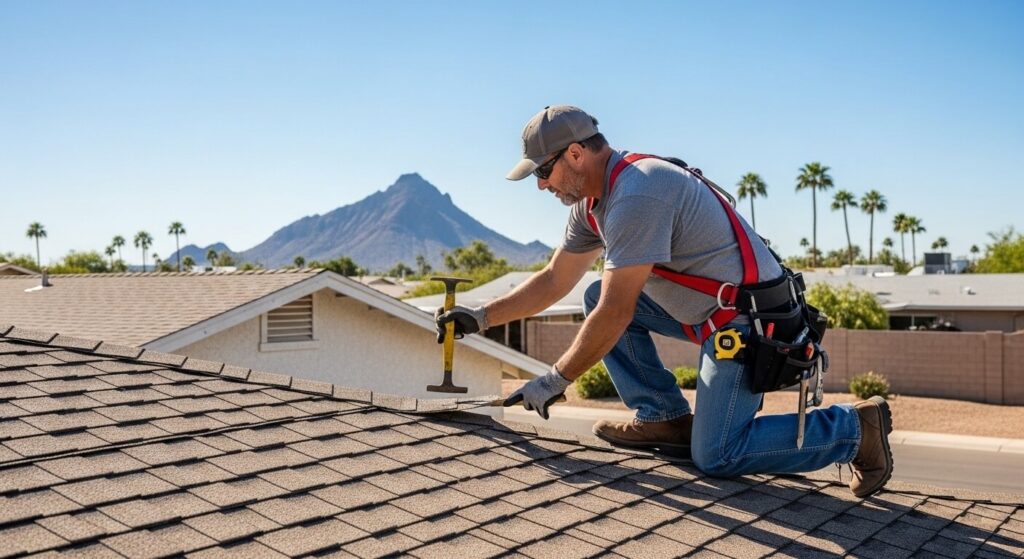
Thermal shock cracking happens when a roofing material heats and cools too quickly for its structure to handle, causing it to expand and contract at a rate that fractures the surface instead of flexing with it — and in Tempe, the most common trigger is a monsoon downpour hitting a roof that’s been baking at 160°F or more in direct sun. Understanding how this differs from ordinary sun damage helps you catch it early, before a hairline crack becomes a leak.
What thermal shock cracking actually is
Every roofing material expands when it heats up and contracts when it cools — that’s normal and roofs are built to handle it over the course of a day. Thermal shock is different. It’s what happens when the temperature swing is sudden and severe rather than gradual, so the material’s surface layer contracts faster than the layers underneath it can follow. That mismatch creates stress the material can’t absorb, and instead of flexing, it splits.
The classic Arizona example is a summer monsoon cell. A tile or shingle roof sitting in full sun during a Tempe afternoon routinely reaches 150-180°F on the surface. When a monsoon storm rolls in, rain temperature is often 40-60 degrees cooler, and it can drop the surface temperature by that much in a matter of minutes. Metal panels and dark asphalt shingles feel this hardest because they conduct and hold heat efficiently — the same property that makes them hot to the touch is what makes the sudden cooling so abrupt.
This is a distinct mechanism from the slow, cumulative breakdown covered in our UV degradation timeline for Arizona roofing materials. UV exposure breaks down a material’s chemistry over months and years. Thermal shock is a mechanical fracture that can happen in a single afternoon, though repeated cycles over many seasons make a roof progressively more brittle and prone to it.
Why Tempe’s climate is especially hard on roofs
Three things about the East Valley’s weather pattern combine to make thermal shock more common here than in most parts of the country. First is the sheer surface temperature roofs reach — triple-digit air temperatures for months push unshaded roof surfaces well past what most manufacturers test materials against. Second is the daily swing: even without a storm, Tempe roofs can see a 40-50°F difference between the hottest part of the afternoon and the pre-dawn low, day after day, for most of the year. Third, and the sharpest trigger, is monsoon season from roughly June through September, when a hot, dry roof can be hit with wind-driven rain in minutes, sometimes alongside hail or wind-lifted debris. Our monsoon roof damage guide covers the storm side in more depth.
Homes in Chandler, Gilbert, and Mesa with large west- and south-facing roof planes tend to see the most extreme surface temperatures, while shaded roofs under mature trees in older Tempe neighborhoods run somewhat cooler with less severe swings.
How each roofing material holds up
Not every roofing material responds to thermal shock the same way. Some are naturally more flexible, some conduct heat faster, and some are installed with expansion built into the design. Here’s how the common options compare.
| Material | How it responds to rapid swings | Relative risk |
|---|---|---|
| Concrete/clay tile | Individual tiles can develop hairline cracks or spall at the surface; the underlayment beneath is more exposed to heat than the tile itself | Moderate |
| Asphalt shingle | Already softened by heat, shingles can crack or lose granules when hit with sudden cool rain, especially once they’re past mid-life | Moderate-high |
| Standing seam metal | Conducts heat fastest of any common material and expands/contracts the most in absolute terms, but panels are engineered with sliding clips for movement | Low (if properly installed) |
| Foam (SPF) | The coating layer can crack or craze under thermal cycling even though the foam substrate stays stable; coating condition matters more than the foam itself | Moderate |
| Flat/low-slope membrane | Seams and flashing transitions are the weak points; large membrane fields can ripple or the seal at penetrations can fatigue | Moderate-high at seams |
For a broader look at which material handles Arizona’s overall climate best — not just thermal shock — see best roofing material for Arizona heat.
Noticed cracking after the last monsoon storm and not sure if it’s cosmetic or structural?
Warning signs to watch for
Thermal shock damage is often subtle at first, which is part of why it goes unnoticed until a leak develops. Look for hairline cracks running across tile faces or shingle tabs, especially in the days right after a monsoon storm rather than during it. On metal roofs, listen for new popping or ticking sounds during rapid temperature changes — that can indicate a fastener or clip working loose from repeated movement. On foam roofs, check for a spider-web pattern of fine surface cracks in the coating, sometimes called crazing, which is different from the larger blistering covered in our post on why foam roof coatings crack and blister. On any material, a scattering of granules in gutters or at downspouts after a storm — beyond what you’d expect from wind alone — is worth a closer look; we cover the shingle-specific version of this in our granule loss guide.
A routine seasonal check is the most reliable way to catch this before it becomes a leak. Our roof inspection and maintenance service and our guide on how often to get a roof inspection both walk through what a proper check should include.
What this looks like on an actual roof
A common pattern after a strong monsoon cell moves through the East Valley: no visible leak the day of the storm, but a water stain on a ceiling weeks later after a second, smaller rain event. What happened in between is thermal shock doing its slow work — the first storm put a hairline crack in a tile or opened a seam at a flashing transition, not enough to leak on its own until a second round of rain found the weak point and worked through the underlayment. This is why post-storm inspections matter even when nothing looks obviously wrong right after — see our guide on what to do in the first hour after storm damage. Catching the hairline crack during a scheduled inspection, rather than waiting for the leak, is almost always the cheaper outcome.
How to reduce thermal shock damage
You can’t change Tempe’s weather, but a few things measurably reduce how hard your roof gets hit by temperature swings. A reflective roof coating lowers peak surface temperature significantly, which shrinks the gap between the hot baseline and the cooler rain — our roof insulation and coating page covers the options for tile, foam, and flat roofs. Keeping attic ventilation working properly also helps, since a well-ventilated attic keeps the underside of the roof deck from adding its own heat back into the equation. And because thermal shock damage tends to be invisible at first, a pre-monsoon inspection each spring catches small cracks and loose fasteners while they’re still a repair rather than a replacement — see our guide on how to spot a roof leak before monsoon season.
Material choice matters too. If you’re planning a replacement anyway, lighter-colored and more reflective materials run cooler and see less dramatic swings; our tile vs. shingle roof replacement comparison and roof replacement cost guide are good starting points if a full replacement is on the table.
Repair vs. replacement
Isolated thermal shock cracks — a handful of split tiles, a small area of crazed foam coating, one or two popped metal fasteners — are almost always a straightforward repair. The calculation changes when the cracking is widespread across the roof or concentrated on a roof that’s already near the end of its expected service life, since a roof that’s brittle enough to crack from thermal cycling in one area is likely to keep cracking elsewhere. Our guide on signs you need a new roof covers how to weigh a pattern of small failures against the cost of a full roof replacement. Material-specific repair guides — tile, shingle, metal, foam, and flat roof — go into what each type of repair typically involves. Commercial buildings with large flat roof areas see a version of this too, and our commercial roof repair page addresses that separately.
Frequently asked questions
Is thermal shock cracking covered by homeowners insurance?
It depends on the cause and your policy. Cracking tied directly to a specific storm event is more likely to be treated as storm damage, while gradual cracking from repeated everyday temperature cycling is more often treated as wear and maintenance, which most policies exclude. Our guide on whether homeowners insurance covers roof damage in Arizona explains how insurers typically draw that line.
How fast can a roof actually cool down during a monsoon storm?
A surface baking at 150-180°F can drop 40-60 degrees within the first several minutes of a heavy downpour, since the rain itself is often only 80-90°F and evaporative cooling speeds the drop further. That speed is what makes the swing damaging, not just the total temperature difference.
Does a light-colored roof really crack less than a dark one?
Generally yes. Lighter, more reflective surfaces run cooler in direct sun, which narrows the gap between peak surface temperature and monsoon rain temperature. It doesn’t eliminate thermal cycling, but it reduces the severity of each swing.
Can thermal shock damage happen without a storm?
Yes, though it’s slower. Daily heating and cooling cycles alone stress a roofing material over time, and a roof that’s already brittle from UV exposure or age is more prone to cracking from ordinary day-to-night swings, not just sudden rain.
How can I tell thermal shock cracks from normal wear?
Thermal shock cracks tend to appear suddenly, often noticeable within days of a specific storm, and follow lines of stress rather than the gradual, even wear pattern of age-related UV breakdown. If you’re not sure, a professional inspection is the reliable way to tell the two apart.
Are metal roofs immune to thermal shock since they’re built for expansion?
Not immune, but more resistant when properly installed. Standing seam systems use sliding clips specifically to accommodate expansion and contraction, so the panels themselves rarely crack. The failure point tends to be fasteners, sealants, or flashing details that weren’t designed with the same tolerance.
Should I get my roof inspected right after every monsoon storm?
A quick visual check after any significant storm is worthwhile, but a full professional inspection once or twice a year — timed before and after monsoon season — is usually enough to catch developing thermal shock damage before it becomes a leak.
Does roof age make thermal shock cracking worse?
Yes. Roofing materials lose flexibility as they age and absorb UV exposure, so a 15-year-old roof is measurably more likely to crack under a rapid temperature swing than a 3-year-old roof of the same material.
Thermal shock cracking is easy to miss because the damage often shows up weeks after the storm that caused it, not during. If you’ve had cracking, popping, or a new leak after a recent monsoon storm, our roof leak repair and emergency roof repair teams serve Tempe and the surrounding East Valley and can trace it back to the source before it spreads.