
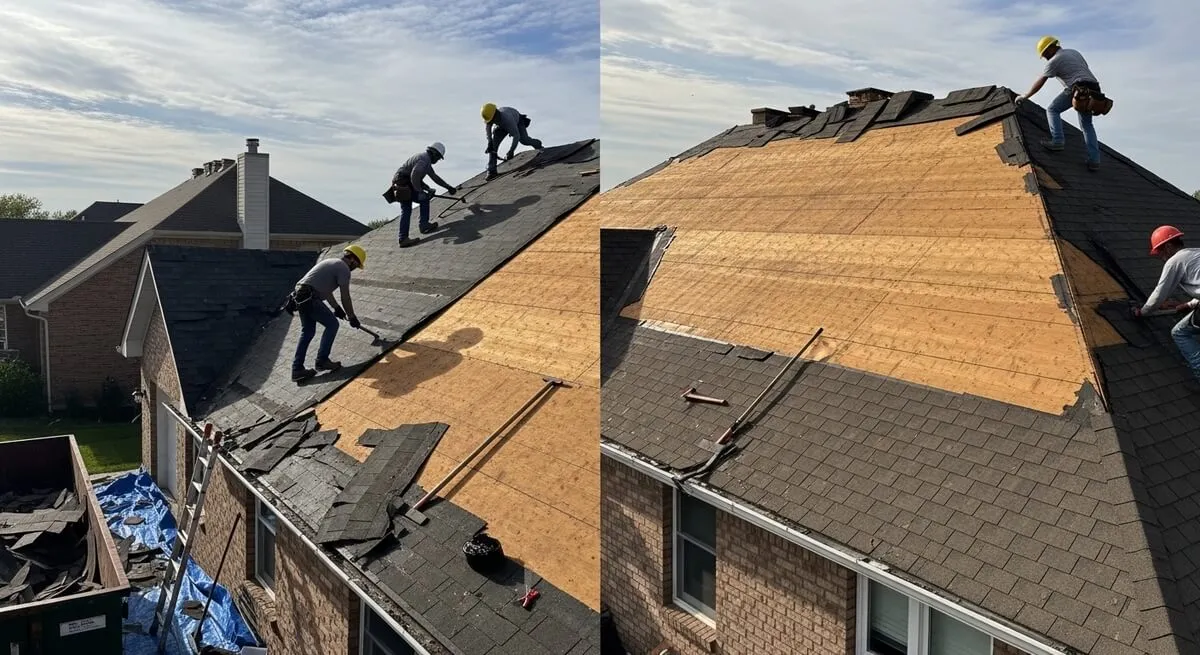
A roof needs full replacement, not repair, when damage is widespread rather than isolated, leaks keep appearing in new spots, or the roof has crossed its material's typical lifespan for Arizona's climate. Below are the ten specific signs worth checking for, the age-based cutoffs by material, and the math for deciding between one more repair and a full replacement.
The 10 signs, at a glance
- Shingles curling, cupping, or losing granules across most of the roof, not just one section
- Multiple cracked, slipped, or missing tiles spread across different roof planes
- A visibly sagging roofline, which points to deck or structural issues
- Daylight visible through the attic decking
- Leaks appearing in different rooms or spots over time, not the same recurring point
- Roof age at or past the typical lifespan for its material
- Repair costs adding up to a large share of what replacement would cost
- Widespread moss, algae, or dark streaking tied to trapped moisture, not just cosmetic staining
- Rising cooling bills without another clear explanation
- Visible storm damage across a large portion of the roof after a major monsoon event
Age-based signs by material
| Material | Typical replacement age | Early warning window |
|---|---|---|
| Asphalt shingle | 15-20 years | Start watching closely at 12-15 years |
| Tile (underlayment) | 20-25 years | Underlayment leaks despite intact tile |
| Flat / foam | 15-20 years (or recoat sooner) | Ponding water, coating wear |
| Metal | 40-60 years | Seam failure, fastener backing out |
For a full comparison of how each material holds up over time, see our guide on the best roofing material for Arizona heat.
Not sure which side of the line your roof is on?
Get a Free Replacement AssessmentVisible exterior signs
- Curling or cupping shingles across multiple roof planes, not isolated to one area facing the harshest sun.
- Heavy granule loss visible in gutters or as bald patches on the shingle surface.
- Cracked or slipped tile in several spots, especially combined with visible underlayment showing through.
- Sagging rooflines anywhere on the structure, which can indicate deck or truss issues beyond the roofing surface itself.
- Rusted, cracked, or lifted flashing around multiple penetrations rather than a single isolated point.
Interior warning signs
- Ceiling stains appearing in more than one room, especially after different storms
- A persistent musty smell in the attic or top-floor rooms
- Visible light gaps in the attic decking during daytime
- Insulation that's damp, compressed, or shows mold growth
Our guide on spotting a roof leak before monsoon season covers how to catch these signs early, before they compound into a replacement decision.
Repair vs. replace decision table
| What we look at | Repair usually fits | Replacement usually fits |
|---|---|---|
| Roof age | Under 15 years old | 20+ years old, with multiple prior repairs |
| Damage scope | Isolated to one area | Widespread across multiple planes |
| Leak pattern | Same single point, now fixed | New spots appearing over time |
| Repair cost vs. replacement cost | Well under 30% of replacement | Approaching 30-50%+ of replacement |
A real-world scenario
A common pattern on an 18-year-old shingle roof in the East Valley: one leak gets patched after a monsoon storm, then a second unrelated leak shows up eight months later on the other side of the house, then granule loss becomes visible in the gutters during a routine check. Individually, each of those looks like a small repair. Together, on a roof already past 15 years, they're the pattern that points to replacement rather than a third patch — repeated repairs on an aging roof often add up to a meaningful fraction of replacement cost within a couple of years, without actually resetting the roof's remaining lifespan.
What happens if you ignore the signs
Deferred replacement on a roof already showing these signs tends to follow a predictable path: small leaks become decking rot, decking rot becomes a structural repair on top of the roofing cost, and trapped moisture creates conditions for mold that's more expensive to remediate than the roof itself. Cooling costs also tend to climb as compromised insulation and ventilation let more heat into the attic during the parts of the year when it matters most. Catching the signs early, ideally through a routine inspection rather than after an emergency, keeps the decision a planned one instead of a forced one.
Self-assessment checklist
- ☐ Roof age is at or past the typical lifespan for its material
- ☐ More than one area shows visible damage, not just one isolated spot
- ☐ Leaks have appeared in more than one location over time
- ☐ Cooling bills have risen without another clear explanation
- ☐ Prior repair costs, added up, are approaching a meaningful share of what replacement would cost
- ☐ A recent major storm caused visible damage across a large portion of the roof
Checking two or more boxes is a reasonable signal to get a professional opinion rather than scheduling another isolated repair.
What replacement actually costs
Most full roof replacements in the Tempe area run between roughly $8,000 and $25,000, with asphalt shingle at the lower end of that range and tile at the higher end, depending on roof size, pitch, and material. Our full roof replacement cost guide breaks that down by material and explains exactly what moves the number. If the damage is storm-related, it's also worth checking whether it's a covered insurance claim before assuming the full cost is out of pocket.
Final thoughts
No single sign on this list automatically means replacement is the only option, but two or three of them appearing together, especially on a roof already near its expected lifespan, usually means another patch is a short-term fix rather than a real solution. A free inspection settles the question with an actual look at the roof rather than guesswork, and it's the same first step whether the answer ends up being one more repair or a full replacement.