
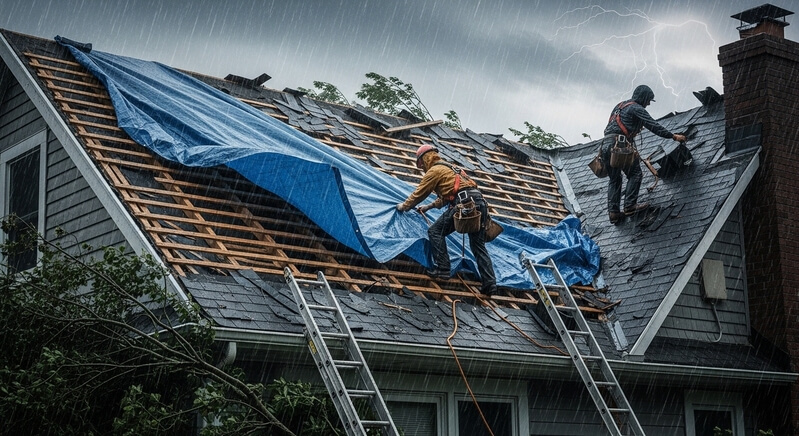
Overhanging tree branches damage roofs two ways: slowly, through years of abrasion that wears away shingle granules or tile glazing every time wind moves a branch against the surface, and suddenly, when a monsoon downburst snaps a limb and drops it straight through the roof deck. Both problems trace back to the same fix — keeping branches trimmed well clear of the roofline — but they call for different responses once damage has already happened.
How overhanging branches damage a roof
Any branch that hangs within a few feet of a roofline is doing something to that roof, even on a calm day. Wind doesn’t need to be dramatic to move a branch tip back and forth against a roof surface — a light afternoon breeze is enough over the course of months, and Arizona’s spring and early-summer wind events make it worse. The contact point wears down whatever it’s resting on: asphalt shingle granules scrub off, tile glazing scratches and dulls, foam coating thins, and metal panel finish scuffs. None of that happens in a single afternoon, so it’s the kind of damage a homeowner rarely notices until a leak shows up somewhere nearby.
The second kind of damage is abrupt. Monsoon microbursts and straight-line wind gusts in the Phoenix area regularly exceed 50-60 mph, more than enough to snap a weak limb or an entire mesquite, palo verde, or eucalyptus branch stressed by drought. When that happens directly over a roof, the branch doesn’t brush against the surface — it lands on it, and depending on size that can mean anything from a few cracked tiles to a punctured deck. This kind of storm-driven branch failure is one of several ways monsoon season damages roofs; our monsoon roof damage guide covers the wind and hail side of that same season.
Slow abrasion vs. sudden impact: what each looks like
These two damage patterns show up differently, and telling them apart matters for how urgently they need attention. Abrasion damage is localized to wherever a branch actually reaches the roof — a worn strip of missing granules along one edge, a scuffed patch of tile glaze, a thinned spot in foam coating always in the same place relative to the tree. It gets worse in the same spot every windy season rather than spreading, and it’s usually found during a routine look at the roof rather than because something failed.
Impact damage shows up all at once, usually tied to a specific storm date the homeowner can name, and it’s often accompanied by visible debris still sitting on the roof. Cracked or displaced tiles, a dented metal panel, torn shingle tabs, or a visible dip in the roof deck under the point of impact are signs the damage needs the kind of prompt attention covered in our emergency roof repair guide rather than a routine maintenance visit.
| Roof type | Abrasion damage | Impact damage |
|---|---|---|
| Asphalt shingle | Granule loss along the contact strip, exposing the asphalt mat beneath — see our guide on granule loss | Torn or lifted shingle tabs, sometimes down to the felt or deck depending on branch size |
| Tile | Surface scratching and glaze wear on field or ridge tiles | Cracked or shattered tiles, occasionally punched underlayment beneath — related to the kind of damage covered in our tile roof repair guide |
| Foam-coated | Thinned or worn coating at the contact point, exposing the foam substrate to UV | Torn or gouged foam, sometimes down to the deck on a direct hit — see foam roof repair |
| Metal / standing seam | Scuffed or scratched finish, which can accelerate rust if the protective coating is worn through | Dented or creased panels, occasionally a compromised seam — covered in our metal roof repair guide |
| Flat / low-slope | Worn or scuffed membrane at the contact point | Punctured or torn membrane, which can mean immediate water intrusion — see flat roof repair |
Have a branch resting on the roofline, or storm debris that landed harder than a light brush?
Leaf and frond debris in gutters and valleys
Overhanging branches don’t have to touch the roof to cause a problem — what falls from them matters just as much. Palm fronds, mesquite leaflets, and eucalyptus bark shed steadily and collect in the two places water is already trying to move fastest: roof valleys and gutters. A valley packed with debris forces monsoon runoff sideways under the shingles or tile instead of down toward the eave, a large part of why valleys are already the leak-prone area covered in our guide on why roof valleys leak more than other areas. Gutters clogged with the same debris back up during a downpour and overflow along the fascia instead of draining, a pattern detailed in our gutter repair guide. Debris buildup also holds moisture against roofing material longer than it would otherwise sit — even a few damp days is enough to soften adhesives and accelerate wear at that spot. A tree that overhangs any part of the roof effectively adds a recurring maintenance item, not just a one-time trimming job.
What to do after a branch falls on your roof
If a branch comes down on the roof, the sequence that keeps the damage from getting worse stays the same whether it’s a small mesquite limb or a larger palo verde branch. First, stay off the roof — a branch that’s already compromised the deck can hide a soft spot that isn’t safe to walk on. Photograph the branch and the visible damage from the ground before anything gets moved, since that documentation matters if a claim gets filed later. If the branch punched through to daylight or there’s active water coming in, a tarp over the affected section is a reasonable temporary step, but leave branch removal itself to a professional if it’s tangled with power lines, gutters, or roofing material.
Once the branch is clear, an inspection needs to look past the obvious puncture point. A branch heavy enough to crack tile or tear shingles often disturbs the surrounding field too — nearby tiles jarred loose, fasteners popped, flashing shifted — so the repair scope is usually larger than just the spot where the branch landed. That’s the same reasoning behind treating any storm-related damage as a job for a full assessment rather than a single-point patch, covered in our guide on the first hour after storm damage.
Trimming clearance: how far back is far enough
The general guidance most arborists and roofers work from is a minimum of 6-10 feet of clearance between any branch tip and the roofline, more for fast-growing or brittle species. That distance accounts for growth between trimmings, the extra reach a branch gets from wind sway, and the added risk from species common in the Valley that are prone to limb failure — eucalyptus and other fast-growing ornamentals in particular tend to drop large limbs with little warning. Mesquite and palo verde are generally sturdier but still shed smaller branches readily during high wind, and palm trees need dead fronds removed on a regular schedule since a dry frond is both a fire hazard and heavy debris waiting for the next gust.
Trimming on a yearly or twice-yearly schedule, timed ahead of monsoon season, keeps clearance from closing back up before it matters. It’s a job for a licensed arborist rather than a roofer, but it pairs naturally with a scheduled roof inspection and maintenance visit — one addresses what’s growing toward the roof, the other checks what’s already worn from branches that were too close last season.
Does insurance cover tree-branch roof damage?
The distinction between abrasion and impact damage matters here too. A tree limb that falls in a windstorm and punctures the roof is typically treated as a sudden, storm-related event, which most homeowners’ policies are built to cover, similar to other wind and hail damage. Slow abrasion from a branch that’s been resting against the roof for months or years is usually classified as a maintenance issue rather than a covered peril, since it results from an ongoing condition the homeowner could have addressed. Our guide on whether homeowners insurance covers roof damage in Arizona goes through how adjusters typically draw that line.
A common Tempe-area scenario
A homeowner in an older, tree-lined neighborhood near downtown Tempe calls after a summer thunderstorm knocks a eucalyptus limb onto the back slope of the roof. From the ground, the damage looks contained to a few broken tiles where the branch hit. Once the branch is removed and a roofer gets up for a full look, the scope is wider: the impact point needs several tiles replaced and the underlayment checked, but a few feet away there’s also a long, unrelated strip of glaze wear where a smaller branch from the same tree has been brushing the roof for what looks like a year or more. The storm damage gets repaired as an insurance claim; the abrasion strip gets flagged as a maintenance item and repaired separately, with a recommendation to trim that tree back before the next windy season closes the gap again.
Frequently asked questions
How close is too close for a tree branch near my roof?
Most roofers and arborists recommend at least 6-10 feet of clearance between a branch tip and the roofline, with more distance for fast-growing or brittle species. Anything closer risks contact during normal wind, not just during a storm.
Can a branch damage my roof without ever falling on it?
Yes. A branch that simply rests against or sways near the roof wears away shingle granules, tile glaze, foam coating, or metal finish over time through repeated light contact, even if it never breaks or falls.
Is it safe to remove a fallen branch myself?
Small, loose debris on the ground is usually fine to clear. A branch still resting on or tangled with the roof, gutters, or power lines is not — call a professional, and stay off the roof itself until it’s been checked for hidden deck damage.
Will my homeowners insurance pay for branch damage?
Often yes for sudden storm-driven impact damage, similar to other wind damage claims. Gradual abrasion damage from a branch that’s been in contact with the roof for a long time is typically treated as a maintenance issue and is less likely to be covered.
Which trees near Tempe homes are the biggest risk to a roof?
Eucalyptus and other fast-growing ornamentals are known for dropping large limbs with little warning. Mesquite and palo verde are generally sturdier but shed smaller branches in high wind, and palm trees need dead fronds removed regularly since they become heavy, fire-prone debris if left in place.
Do I need a roofer or an arborist for this problem?
Both, usually for different parts of it. An arborist handles trimming and clearance around the roofline; a roofer assesses and repairs whatever damage the branches have already caused, whether that’s abrasion wear or storm impact.
How often should debris be cleared from valleys and gutters near overhanging trees?
A tree that overhangs any part of the roof usually needs valleys and gutters checked more often than a roof with no nearby trees — a quick look every few months, and always after a windstorm or monsoon event, keeps debris from building up enough to redirect water under the roofing material.
What does branch abrasion damage actually look like up close?
A worn strip or patch right where the branch reaches the roof — missing granules on shingle, dulled or scratched glaze on tile, thinned coating on foam, or scuffed finish on metal. It stays in roughly the same spot and gets more pronounced each windy season until the tree is trimmed back.
Whether the issue is a branch that’s been quietly wearing a strip of granules off for a year or one that came down hard enough to crack tile, the fix starts with a full look at the roof, not just a glance at the obvious damage. If you’ve got a tree overhanging any part of your roofline, a roof inspection can catch abrasion wear before it becomes a leak, and if a branch has already come down, our team can help you sort out what’s covered, what’s not, and what it takes to get it repaired before the next storm rolls through. Wind-driven debris carried inside a haboob dust storm causes this same kind of impact damage, often just minutes before the rain that reveals it arrives.